What should I do now?
Call 911
Call 911 if racing occurs with chest pressure, severe trouble breathing, fainting, or severe weakness or dizziness. Do not drive yourself.
Contact your care team
Contact your care team if episodes are new, more frequent, longer, or interfere with daily life. Follow your personal plan when an episode will not stop.
Keep your care plan
Keep your treatment and follow-up plan. Bring questions, readings, and your medication list.
HEART MADE CLEAR · SVT · SECTION 4
How is SVT treated?
Treatment has two goals: stop SVT when it happens and prevent it from returning. The best approach depends on your type of SVT, your symptoms, and your preferences.
Stopping an episode
Vagal maneuvers: Your care team may teach you a specific bearing-down technique called the Valsalva maneuver. It temporarily slows electrical signals through the AV node and can interrupt AVNRT or AVRT. Do not massage your neck yourself or delay emergency care for severe symptoms.
Medication during an episode: In a monitored medical setting, adenosine can briefly block signals through the AV node and stop many episodes of AVNRT or AVRT. It works quickly and wears off quickly. Atrial tachycardia may require a different approach because its electrical source can continue firing independently of the AV node.
Electrical cardioversion: A controlled electrical shock may be needed if SVT causes severe symptoms or appropriate medications do not stop it. Cardioversion resets the rhythm, but the underlying pathway or source remains, so episodes can return.
Preventing future episodes
Medications: Beta blockers, certain calcium channel blockers, or selected rhythm medications may help reduce episodes. They generally do not remove the electrical pathway or source. Each medication has potential side effects and must be taken as prescribed.
Catheter ablation: An electrophysiologist identifies and treats the small area of tissue responsible for SVT. Ablation can provide a lasting cure for many common types.
How does ablation treat each type?
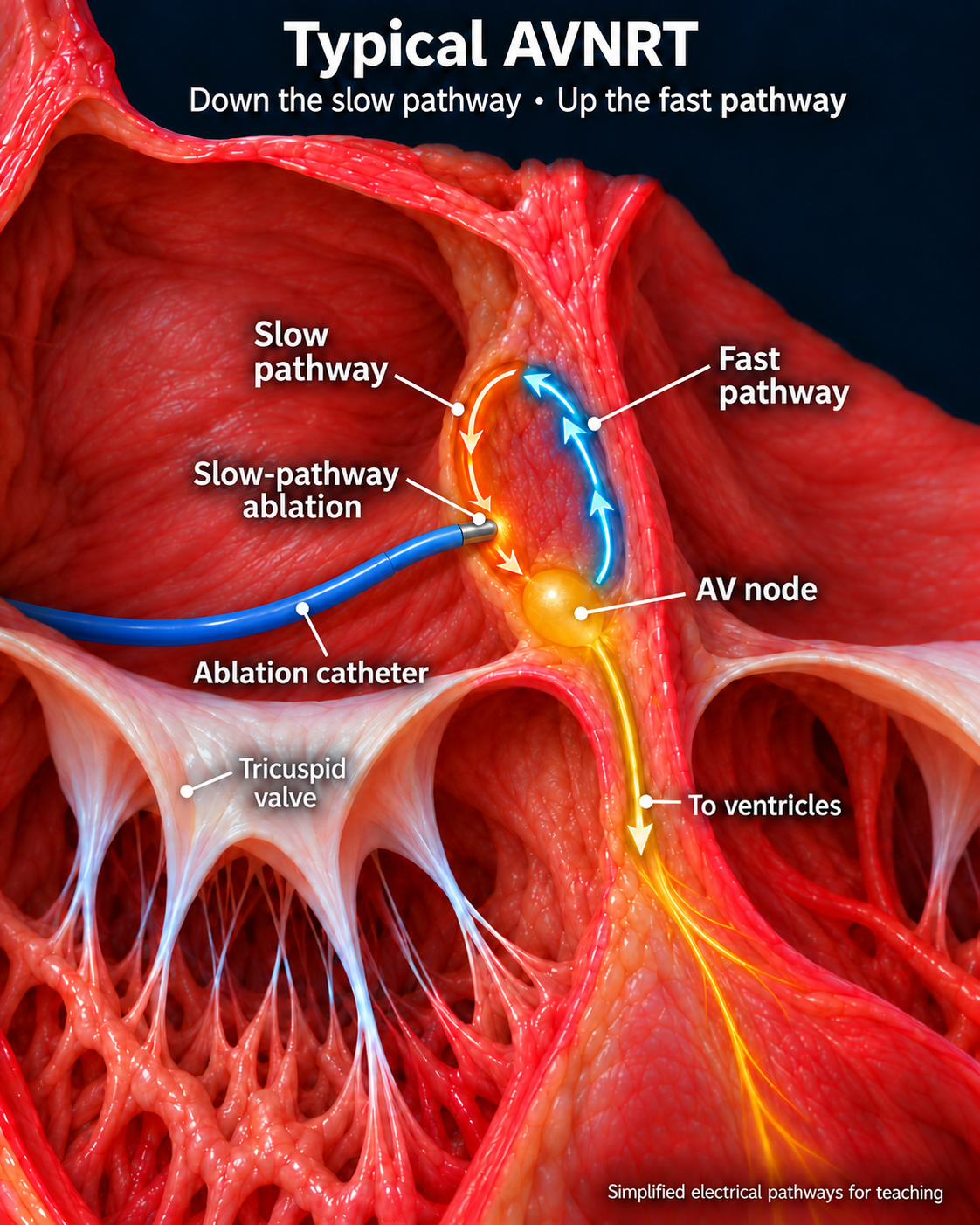
AVNRT: treating the slow pathway
Ablation usually modifies the slow pathway, preventing the signal from completing its loop while aiming to preserve normal AV node conduction.
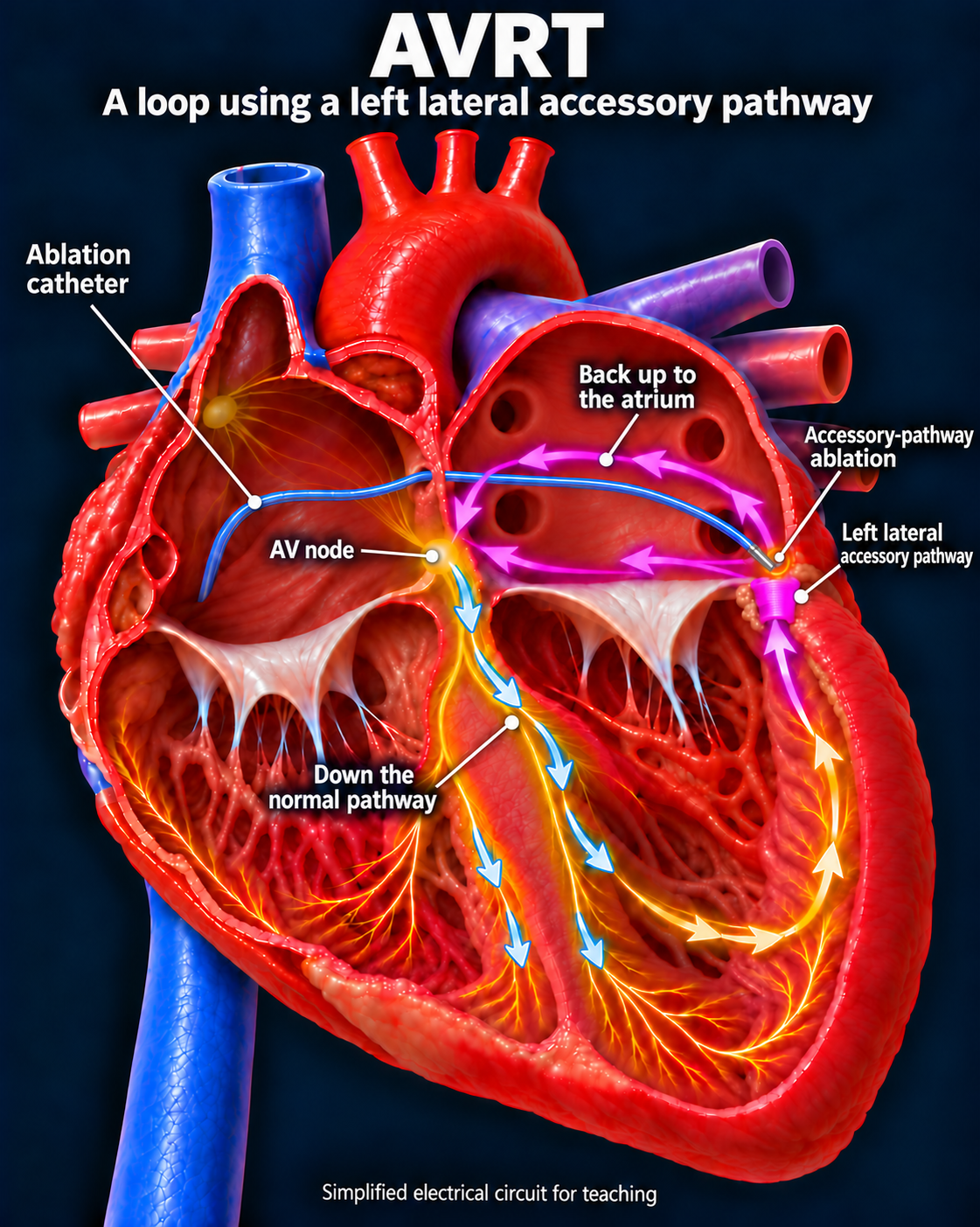
AVRT: blocking the accessory pathway
Ablation blocks the accessory pathway, removing the extra connection needed to sustain the circuit.
Focal atrial tachycardia: treating the source
Ablation targets the extra electrical source, preventing that area from driving the heartbeat.
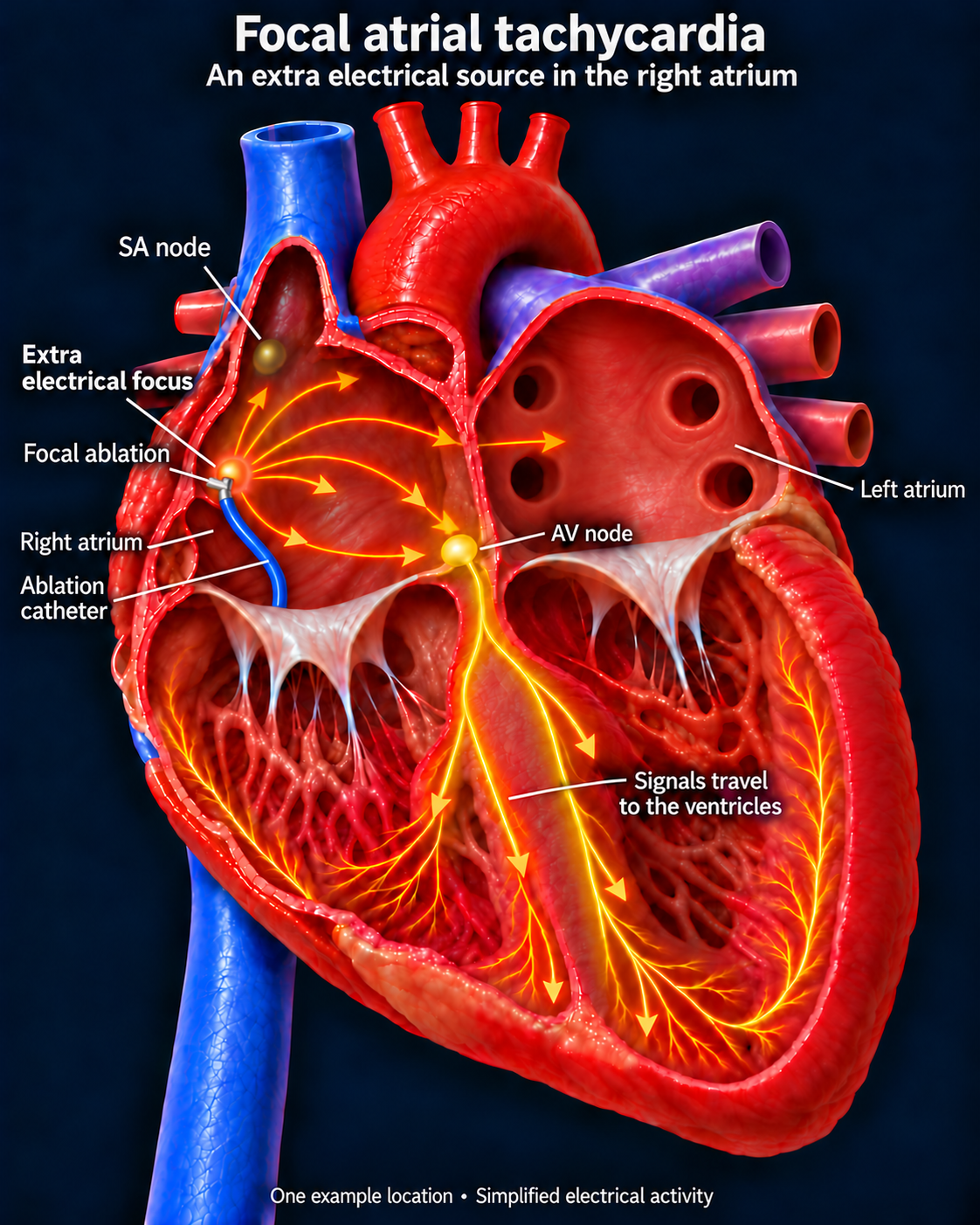
Illustrations simplify the anatomy and catheter positions to explain the treatment target.
Is ablation right for me?
You do not always need to try long-term medication before discussing ablation. It can be an initial treatment choice for appropriate patients.
Success and risks depend on the type and location of the SVT. Your EP will explain the benefits and risks, including bleeding, damage to nearby structures, and possible heart block requiring a pacemaker when treatment is close to the normal conduction system.
Some patients with infrequent, brief, minimally bothersome episodes choose observation with a clear action plan.
The goal: Choose a treatment that controls your SVT and fits your life.
Preparing for your ablation?
Learn about procedure day, recovery, and caring for your groin puncture sites at home.
What to expect on my procedure dateUpdated October 2026. Educational information; your own care plan may differ.