What should I do now?
Call 911
Call 911 for chest pressure, severe trouble breathing, fainting during a racing heartbeat, or stroke signs. Do not drive yourself.
Contact your care team
Contact your care team for recurrent racing, worsening fatigue, reduced activity, or medication and bleeding concerns.
Keep your care plan
Keep your treatment and follow-up plan. Bring questions, readings, and your medication list.
04 / TREATMENT
How is atrial flutter treated?
Treatment has three pillars: reduce stroke risk, control the heart rate, and restore and maintain normal rhythm. Your care team builds a plan around your symptoms, heart function, and individual risks.
04 / TREATMENT · PILLAR 1
Reduce the risk of stroke
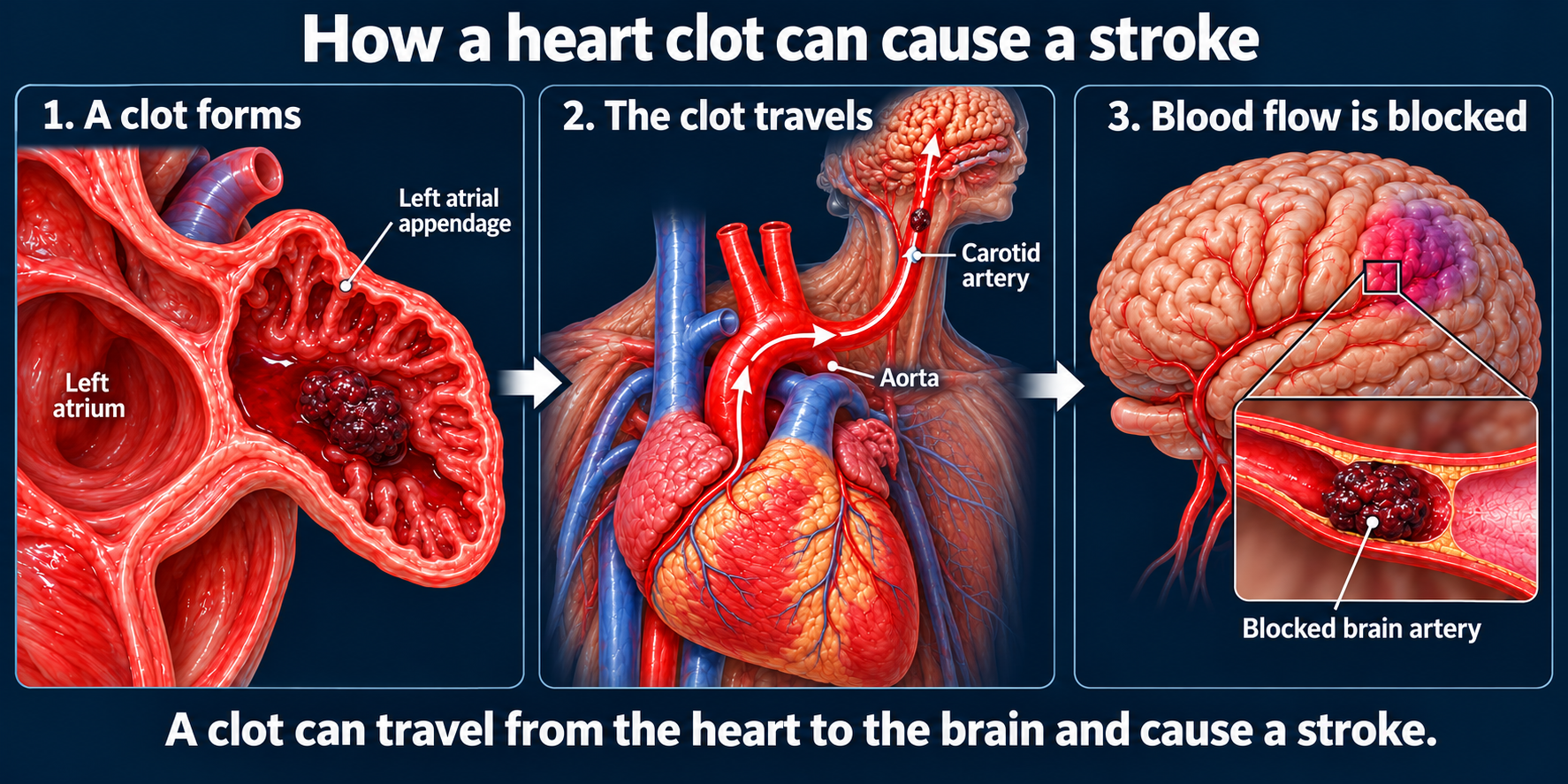
Atrial flutter can allow blood clots to form in the heart. A clot may form in the left atrial appendage (LAA), travel out of the heart, and block an artery supplying the brain, causing a stroke.
How do we decide whether you need a blood thinner?
Your care team uses a stroke-risk scoring system, commonly called CHA₂DS₂-VASc, to help decide whether you need a blood thinner. It considers factors such as age, high blood pressure, diabetes, heart failure, and a previous stroke.
How do blood thinners help?
Blood thinners reduce the blood’s ability to form clots. These medicines are called anticoagulants. Those taken by mouth are called oral anticoagulants, or OACs.
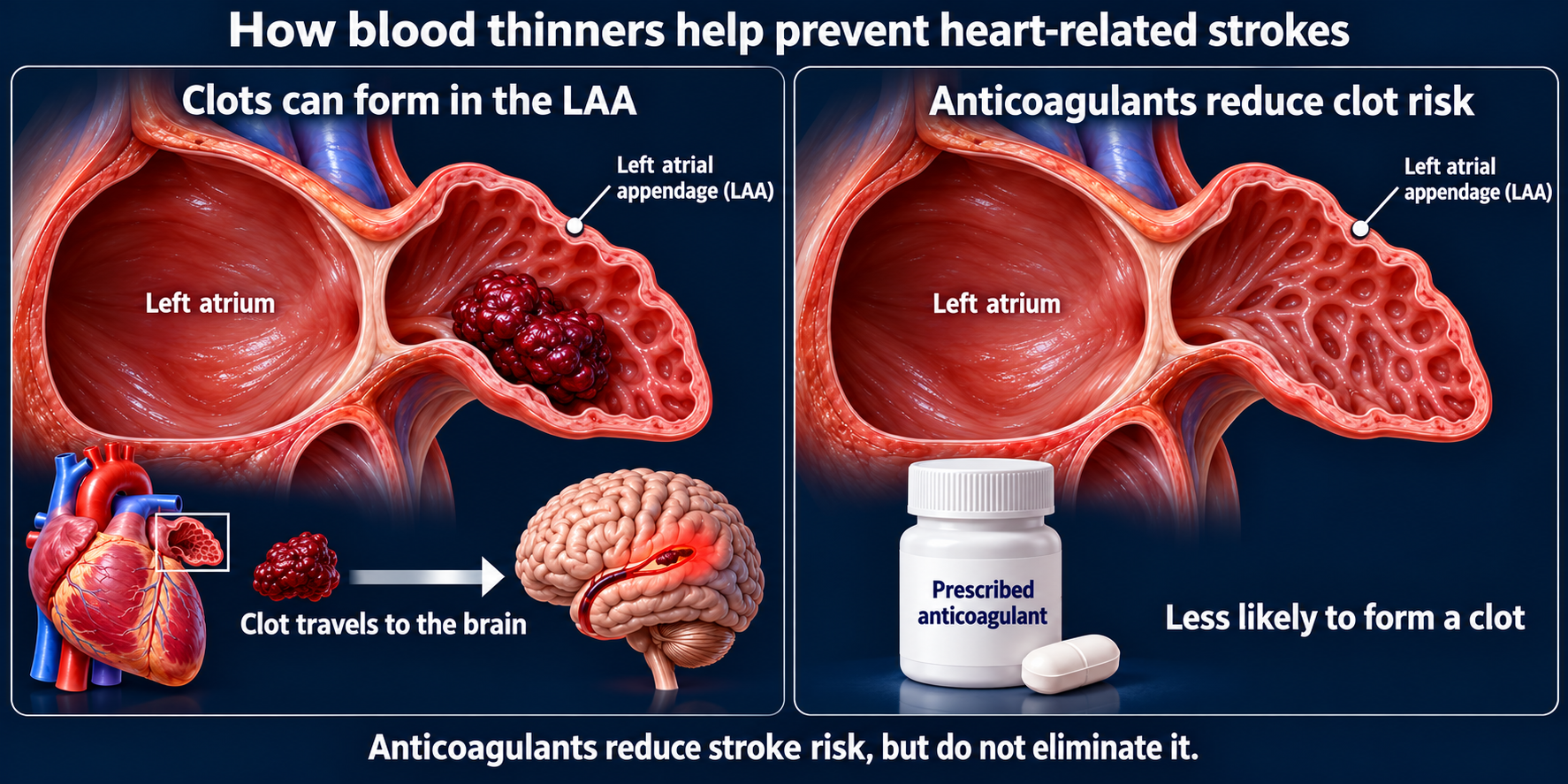
Blood thinners help protect against a clot-related stroke, but they do not stop flutter or control the heart rate.
Will I still need a blood thinner after treatment?
Blood thinners may also be needed before and after cardioversion or ablation. Whether you need them longer depends on your individual stroke risk, any history of AFib, and your follow-up findings.
04 / TREATMENT · PILLAR 2
Control the heart rate
Rate-control medications slow the number of electrical signals that pass through the AV node to the ventricles—the heart’s lower chambers.
Examples include beta blockers, such as metoprolol, and certain calcium channel blockers, such as diltiazem or verapamil. Your clinician selects a medication based on your heart function, blood pressure, and other health conditions.
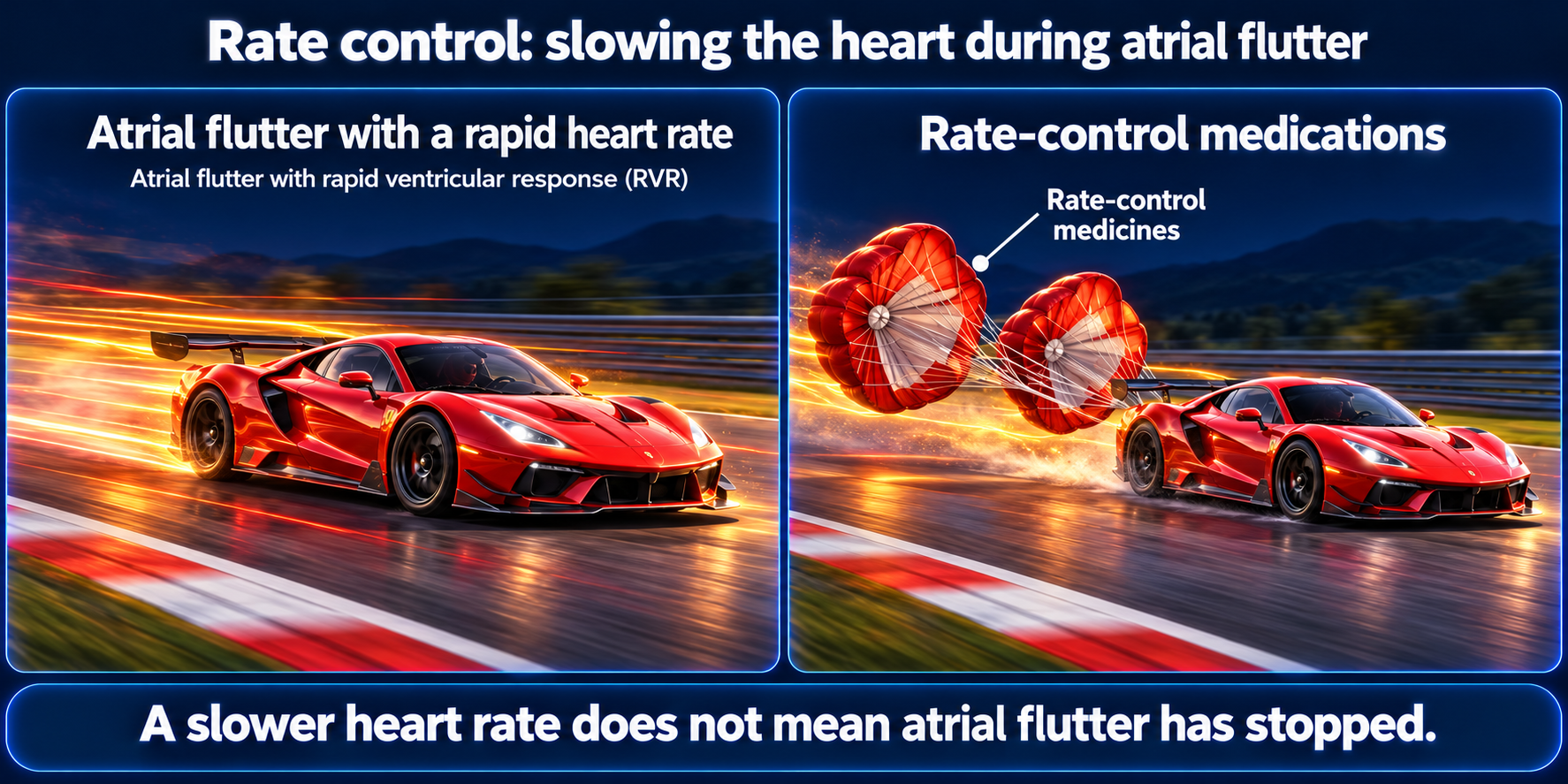
These medicines can improve symptoms and help protect the heart from weakening because of a persistently rapid pulse. They usually do not stop the flutter circuit itself. The atria may remain in flutter even when your pulse slows.
Why are medications often not enough?
Atrial flutter is often difficult to control with rate-control medications. In some patients, the pulse remains too fast despite appropriate treatment—even when more than one medication is used. These medicines slow conduction through the AV node, but they do not eliminate the electrical loop that keeps flutter going.
Catheter ablation treats the flutter circuit directly by creating an electrical barrier that prevents the signal from completing its loop. It is often the preferred definitive treatment for typical atrial flutter, particularly when symptoms persist or medications cannot adequately control the rate. Atypical flutter can also be treated with ablation, although it is more complex and may recur.
04 / TREATMENT · PILLAR 3
Restore and maintain a normal rhythm
Rhythm control treats the abnormal rhythm itself. The goal is to stop atrial flutter and help the heart return to normal sinus rhythm, improving symptoms and allowing the upper and lower chambers to work together with their normal timing.
The main options are electrical cardioversion, rhythm-control medications, and catheter ablation.
Option 1: Electrical cardioversion—reset the rhythm
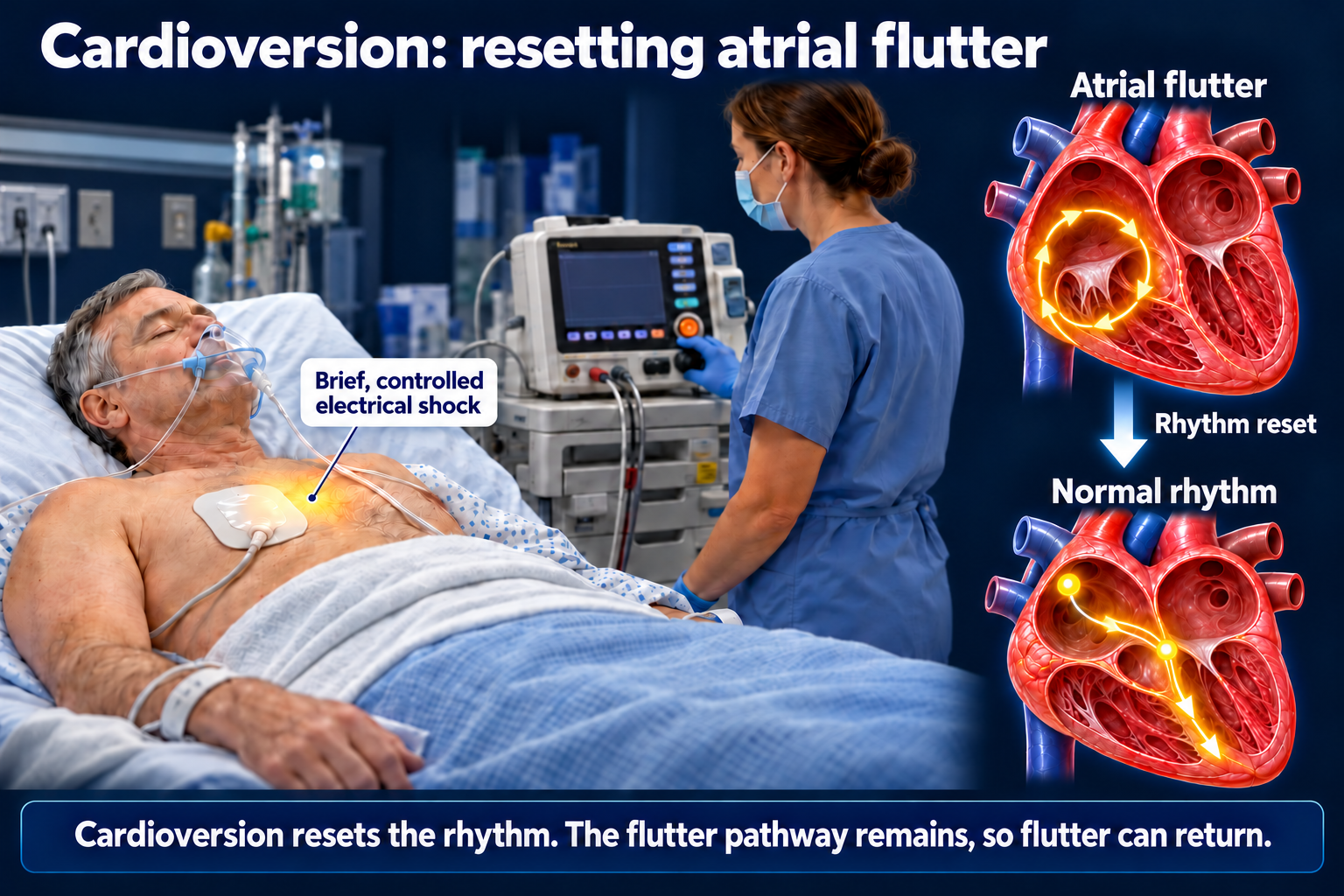
Electrical cardioversion uses a controlled electrical shock delivered through pads on the chest to restore a normal rhythm. For a planned procedure, medication keeps you asleep and comfortable.
The shock interrupts the circulating electrical signal, allowing the heart’s normal pacemaker to take over. It stops the current episode, but it does not remove the pathway that caused flutter. Atrial flutter can return.
Your care team arranges appropriate blood-thinner treatment and, when needed, imaging to check for a clot before cardioversion.
Option 2: Rhythm-control medications—help maintain normal rhythm
These medicines, also called antiarrhythmics, change how electrical signals travel through the heart. Some can help stop an abnormal rhythm; others help maintain normal rhythm after cardioversion.
Unlike rate-control medications, they treat the rhythm itself. However, they do not permanently remove the flutter circuit, and flutter may return. They must be taken as prescribed to provide their intended benefit.
Each medication has its own side effects and monitoring needs. Some require EKG checks or blood tests, and some must be started in a monitored hospital setting. Your clinician considers your heart function, kidney function, other medicines, and medical history when selecting treatment.
Option 3: Catheter ablation—interrupt the electrical loop
An electrophysiologist, or EP, guides thin catheters through blood vessels into the heart to identify and treat the flutter pathway. Ablation creates an electrical barrier. If the signal cannot complete its loop, that flutter circuit cannot continue.
Typical flutter: block the CTI pathway
Typical flutter travels around the tricuspid valve in the right atrium. The circuit passes through the narrow strip of tissue between the valve and the inferior vena cava, called the cavotricuspid isthmus (CTI).
The EP creates a line of ablation across this pathway, from the tricuspid valve to the inferior vena cava. The line blocks electrical travel across the CTI. The EP checks that signals cannot cross the line in either direction.
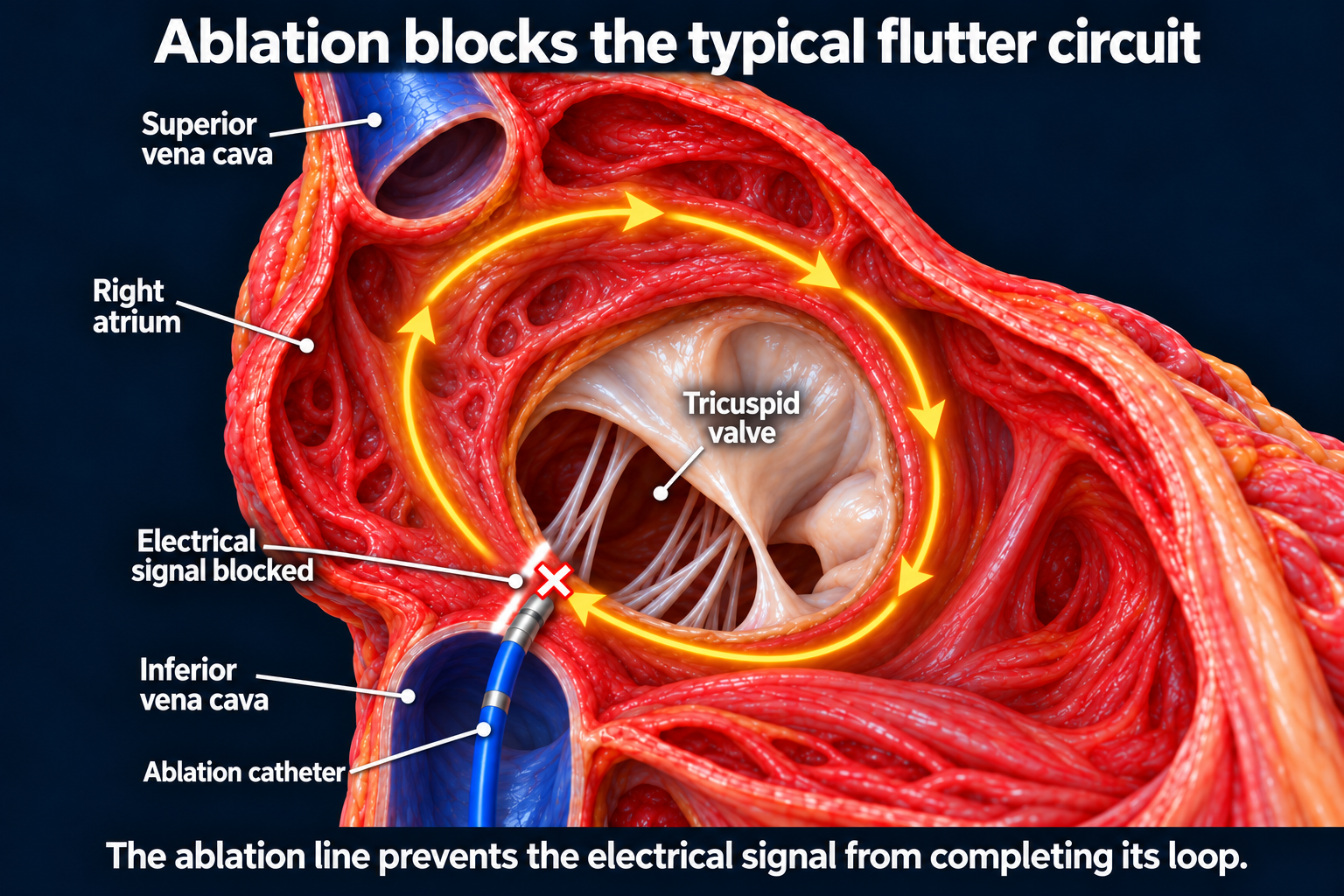
Ablation is highly effective for typical flutter and can permanently eliminate that particular circuit. It is often the preferred definitive treatment, especially when flutter causes symptoms or medications cannot adequately control the heart rate.
Atypical flutter: map and treat a different pathway
Atypical flutter may circle an area of scar, the mitral valve, or another pathway in either atrium. The EP uses detailed electrical mapping to find the active circuit and identify the critical tissue keeping it going.
Ablation then creates a targeted barrier to interrupt that pathway. Atypical flutter is more complex to treat. Results depend on the circuit and the surrounding tissue; signals may reconnect or another circuit may develop, so additional treatment is sometimes needed.
What happens after ablation?
Treating a flutter circuit does not necessarily prevent AFib or a different flutter circuit. Follow-up visits and rhythm monitoring help your care team assess the result and adjust your treatment.
Do not stop blood thinners or other prescribed medicines on your own. Your care team decides which medicines are still needed based on your individual risks and follow-up findings.
Preparing for your ablation?
Learn about procedure day, recovery, and caring for your groin puncture sites at home.
What to expect on my procedure dateUpdated October 2026. Educational information; your own care plan may differ.