What should I do now?
Call 911
Call 911 for chest pressure, severe trouble breathing, fainting during a racing heartbeat, or stroke signs. Do not drive yourself.
Contact your care team
Contact your care team for recurrent racing, worsening fatigue, reduced activity, or medication and bleeding concerns.
Keep your care plan
Keep your treatment and follow-up plan. Bring questions, readings, and your medication list.
03 / FINDING THE RHYTHM
How is atrial flutter diagnosed?
Atrial flutter is diagnosed by recording the heart’s electrical activity. The most common test is an electrocardiogram, also called an ECG or EKG. Small stickers placed on your chest and limbs record the electrical signals and help your care team identify the rhythm.

An EKG can show the repeating atrial signals called flutter waves. Typical flutter often has a sawtooth appearance, while atypical flutter may look different. Your clinician reviews the recording to distinguish flutter from AFib and other heart rhythms.
Normal rhythm compared with atrial flutter
Normal sinus rhythm
In normal sinus rhythm, one small P wave appears before each tall QRS complex. There are no rapid, repeating flutter waves between beats.
Atypical atrial flutter: our earlier example
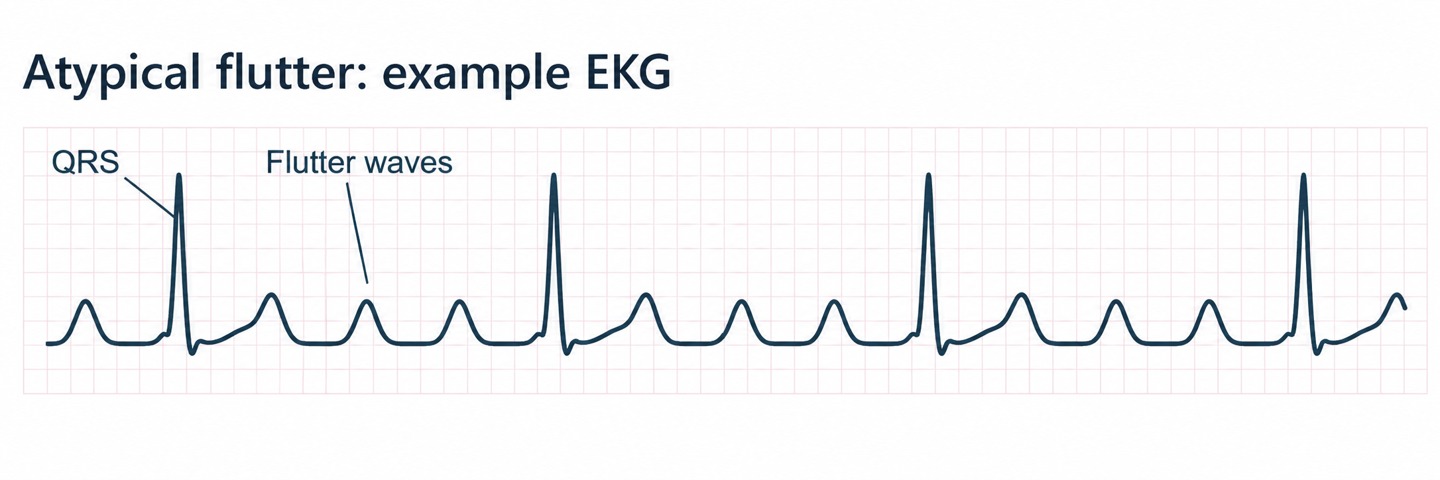
These are illustrations, not patient recordings. Flutter-wave appearance varies. Atypical flutter does not have one fixed EKG pattern, and the EKG alone may not identify the exact circuit.
What if the flutter comes and goes?
An office EKG is a brief snapshot. If flutter is not happening during the appointment, your clinician may recommend a monitor that records your rhythm for longer.
- A Holter monitor: Records continuously during normal daily activities.
- A patch monitor: Worn on the chest to record the rhythm over several days or longer.
- An event monitor: Helps capture episodes that happen less often.
Can a smartwatch detect flutter?
Some watches and handheld devices can record a short EKG that provides useful information. Save the recording and share it with your care team.
However, watches may miss atrial flutter or label it as AFib, a normal rhythm, or an inconclusive result. Flutter can produce a regular pulse, so an irregular-pulse alert may never occur. A watch’s automatic interpretation should not be used by itself to confirm or rule out flutter.
What about a blood pressure cuff or finger oxygen monitor?
A standard blood pressure cuff or finger pulse oximeter may show a fast pulse or flag an irregular heartbeat, but it cannot diagnose atrial flutter. These devices measure the pulse rather than recording the electrical signals needed to identify the rhythm.
Will I need other tests?
Your clinician may recommend a heart ultrasound or blood tests to assess heart function and look for contributing conditions. These tests help guide treatment, but they do not replace an EKG or rhythm recording.
If ablation is being considered, an electrophysiologist may use detailed electrical mapping during the procedure to identify the flutter circuit.
Updated October 2026. Educational information; your own care plan may differ.