What should I do now?
Call 911
Call 911 for chest pressure, severe trouble breathing, fainting, or severe dizziness with palpitations. Do not drive yourself.
Contact your care team
Contact your care team for new or increasingly frequent palpitations, reduced activity, or troublesome symptoms.
Keep your care plan
Keep your treatment and follow-up plan. Bring questions, readings, and your medication list.
SECTION 4
How are PACs and PVCs treated?
We treat premature beats when they cause bothersome symptoms or when their frequency raises concern about the heart’s function. Treatment depends on whether you have PACs or PVCs, how often they occur, and the health of your heart.
The goal is to help you feel better and protect your heart’s pumping function—not necessarily eliminate every occasional early beat.
1. Observation and reducing triggers
If premature beats are occasional, symptoms are mild, and the heart is healthy, reassurance and follow-up may be enough.
Your care team may recommend:
- Getting adequate sleep and staying appropriately hydrated.
- Reducing excessive caffeine or alcohol, especially if they trigger your symptoms.
- Avoiding tobacco and recreational stimulants.
- Reviewing medications, supplements, and decongestants that may contribute.
- Treating contributing conditions, such as an electrolyte imbalance or thyroid problem.
Reducing triggers may help, but frequent or symptomatic premature beats can still require additional treatment.
2. Medications: suppressing premature beats
Beta blockers are commonly used to reduce symptoms and may decrease the number of premature beats. Certain calcium channel blockers may be appropriate for selected patients, particularly those with PVCs.
If these are ineffective, an EP may consider a rhythm-control medication. The choice depends on your heart’s pumping function, other heart conditions, and potential side effects.
Medications try to suppress the early electrical signals. They do not remove the source. They must be taken as prescribed, and some require EKG or laboratory monitoring.
3. Catheter ablation: targeting the electrical source
During ablation, an electrophysiologist uses thin catheters to map where the premature beats begin. Energy is then applied to a small area of tissue to stop it from producing those signals.
This is a catheter procedure rather than open-heart surgery.
Ablation for PVCs
Ablation may be appropriate when:
- PVCs cause significant symptoms.
- Medications are ineffective, cause side effects, or are not preferred.
- Frequent PVCs are causing—or are strongly suspected of causing—weakening of the heart muscle.
For certain PVC locations, ablation can be an initial treatment option. You do not always need to try several medications first.
When PVCs are responsible for reduced pumping function, successfully suppressing them can allow the heart to improve. Recovery varies, especially if another heart condition is also present.
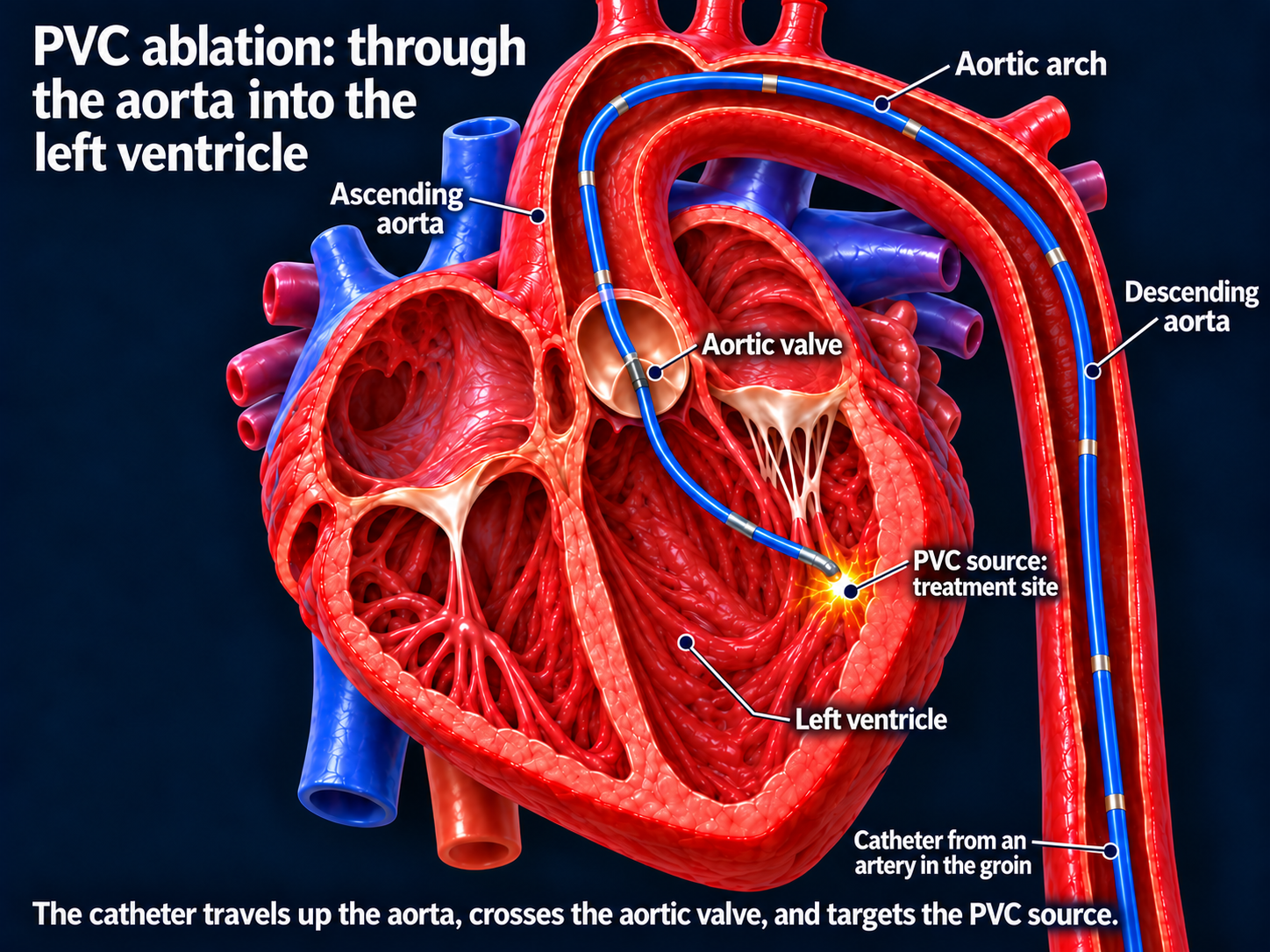
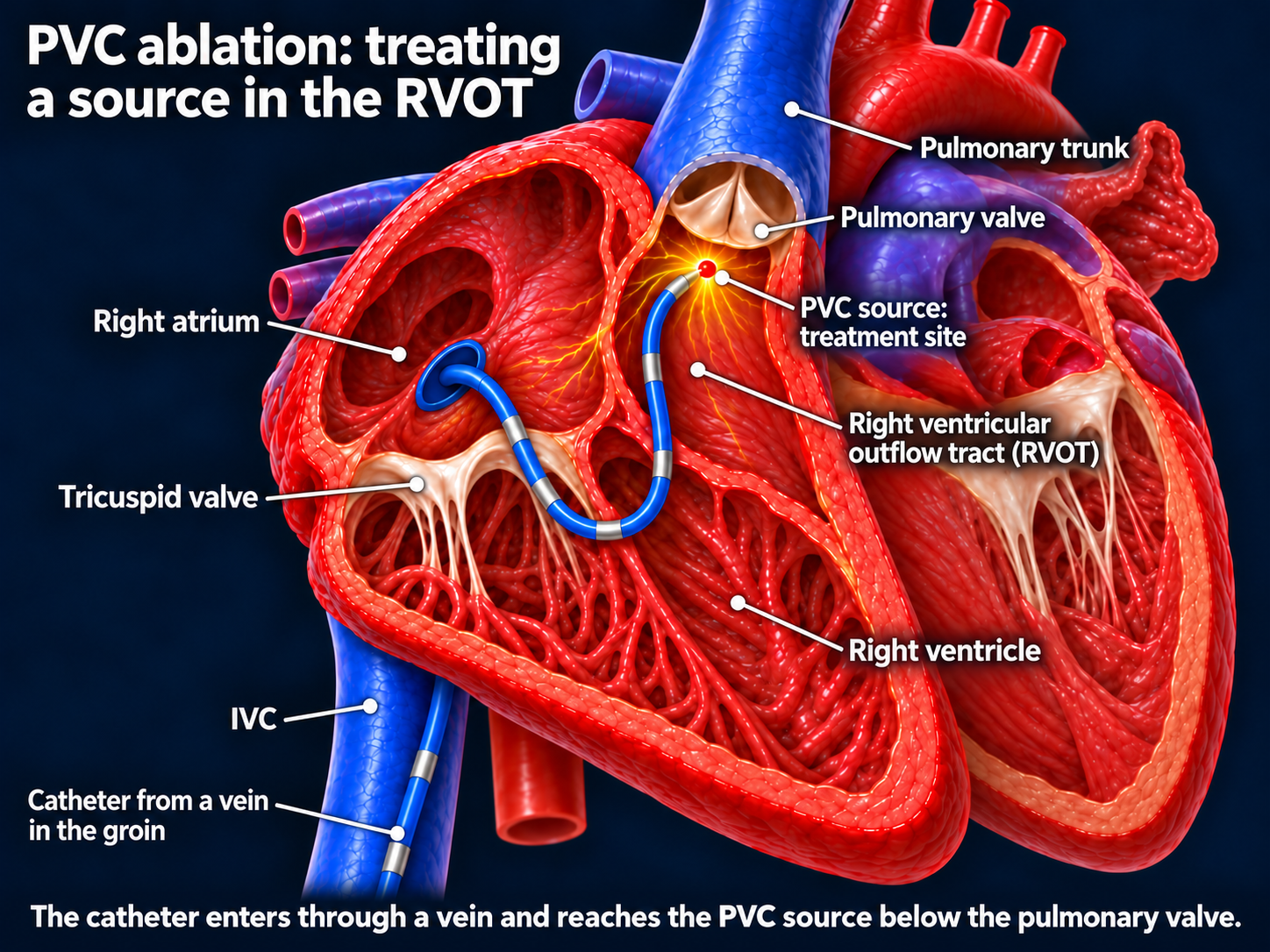
PVCs can start in different ventricular locations. These are two examples; the catheter route depends on the source.
Example: a PVC source in the left ventricle
Example: a PVC source in the RVOT
Ablation for PACs
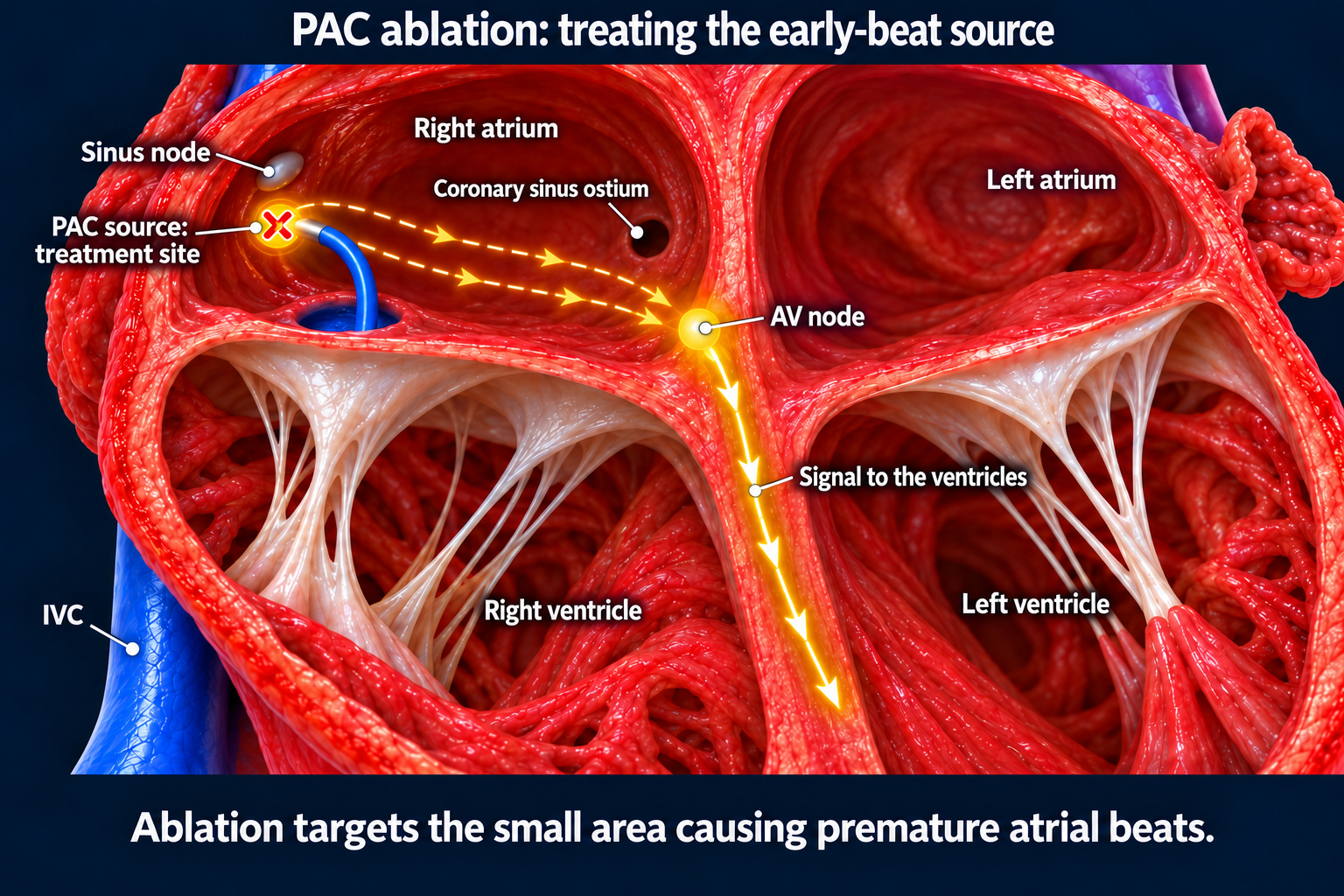
Most PACs do not require ablation. However, an EP may consider it in selected patients with frequent, troublesome PACs that persist despite other treatment.
The approach depends on where the PACs begin. If they trigger another rhythm, such as AFib, that rhythm may also need its own treatment plan.
How effective is ablation?
Success depends on the location of the source, whether there are multiple sources, and whether enough premature beats occur during the procedure to map them.
Some locations are more difficult to reach or are close to important structures. Your EP will discuss expected benefits and risks, including bleeding, injury to the heart or nearby structures, and possible damage to normal electrical conduction.
Ablation can provide lasting relief, but premature beats can return or arise from a different location.
Choosing your treatment
Your symptoms matter—even if your heart’s pumping function is normal. Likewise, frequent PVCs may need attention even when you barely feel them.
Together, you and your care team can choose observation, medication, or ablation based on your symptoms, rhythm recordings, heart function, and preferences.
Preparing for your ablation?
Learn about procedure day, recovery, and caring for your groin puncture sites at home.
What to expect on my procedure dateUpdated October 2026. Educational information; your own care plan may differ. Heart illustrations and EKG examples are simplified for teaching.