What should I do now?
Call 911
Call 911 for fainting, chest pressure, severe trouble breathing, or severe dizziness that makes you feel you may pass out. Do not drive yourself.
Contact your care team
Contact your care team for new dizziness, unusual fatigue, near-fainting, or a drop in activity. Report device-site concerns promptly after implantation.
Keep your care plan
Keep your treatment and follow-up plan. Bring questions, readings, and your medication list.
SECTION 1
What is a slow heartbeat or heart block?
Bradycardia means a slow heart rate. In adults, a resting pulse below 60 beats per minute is commonly called bradycardia. However, a slow rate can be normal during sleep or in physically fit people. The number alone does not tell us whether something is wrong.
How does the heart normally beat?
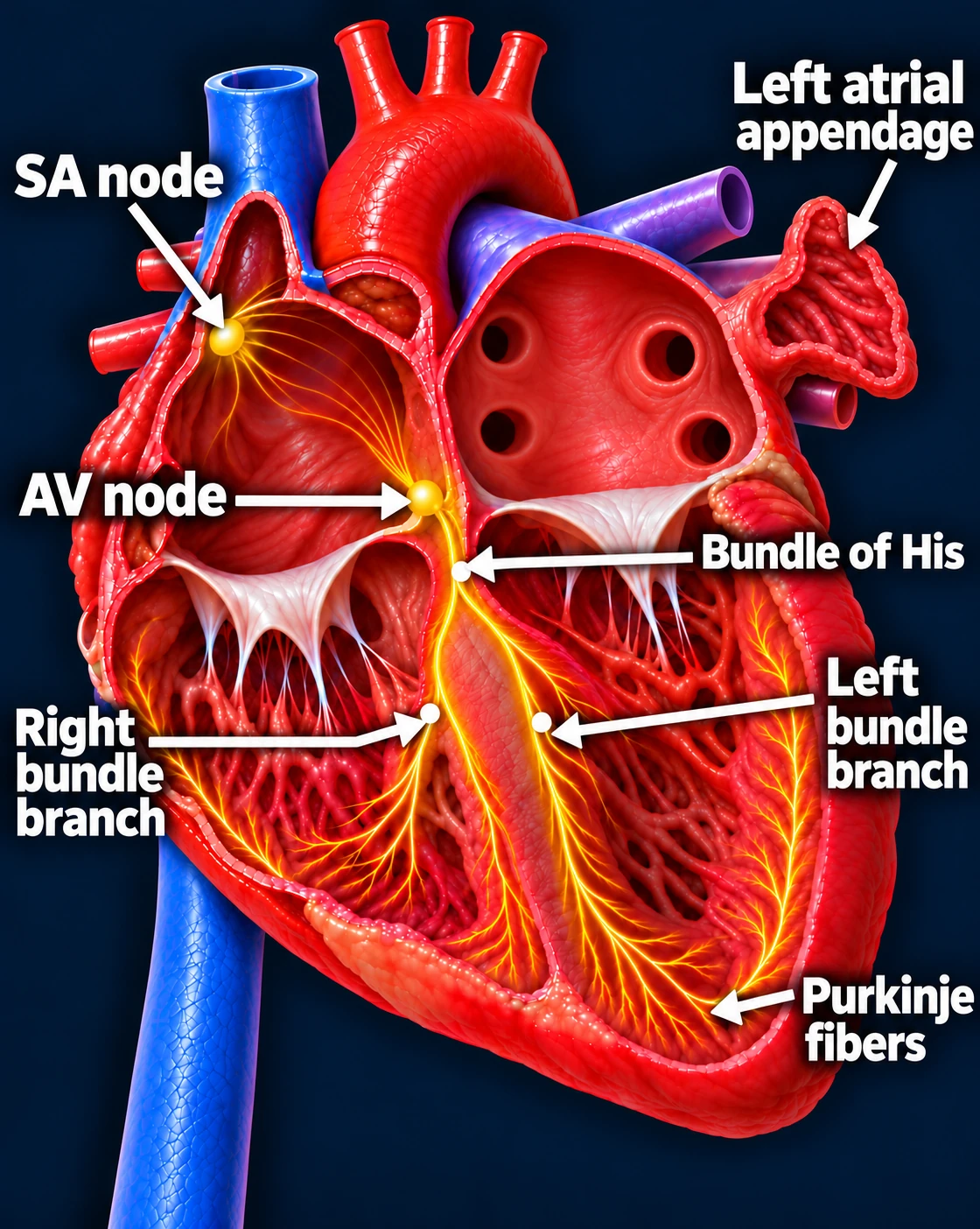
Follow one normal heartbeat
SA node → Atria → AV node → Ventricles
- The SA node starts the signal. The heart’s natural pacemaker in the right upper chamber begins each normal sinus beat.
- The signal spreads through both atria. The upper chambers contract, moving blood into the ventricles.
- The AV node briefly delays the signal. This pause gives the ventricles time to finish filling.
- The signal activates the ventricles. It travels through the bundle of His, right and left bundle branches, and Purkinje fibers. The lower chambers contract, pumping blood to the lungs and body.
The atria contract first; the ventricles follow. This organized sequence produces a coordinated heartbeat.
Normal conduction begins at the SA node, passes through the AV node and bundle of His, and travels down the right and left bundle branches to the Purkinje fibers. The left atrial appendage is also labeled for orientation.
Two different electrical problems
Sinus node dysfunction: The problem begins with the natural pacemaker. It may start signals too slowly, pause, or fail to increase the heart rate enough during activity. This is sometimes called sick sinus syndrome.
Heart block: The sinus node may start signals normally, but those signals are delayed or blocked on their way to the ventricles. The problem can occur at the AV node or farther down the electrical wiring.
These are simplified examples; the exact location and degree of the problem can vary.
Heart block is an electrical problem. It does not mean that an artery is blocked.
What are the different degrees of heart block?
- First-degree: Every atrial signal reaches the ventricles, but the trip takes longer than usual. This is a delay rather than a completely blocked beat.
- Second-degree: Some atrial signals do not reach the ventricles. There are different patterns, including Mobitz I and Mobitz II, with different implications.
- Third-degree, or complete heart block: No atrial signals reach the ventricles. The lower chambers may depend on a slower backup rhythm, which can be unreliable. This requires prompt medical evaluation.
Does every slow heartbeat need a pacemaker?
No. Your clinician considers the rhythm, your symptoms, and whether there is a reversible cause. Certain serious forms of heart block may need a pacemaker even when symptoms are absent.
The key idea: Sinus node dysfunction is a problem with starting the signal. Heart block is a problem with getting the signal to the lower chambers.
Updated October 2026. Educational information; your own care plan may differ. Heart illustrations are simplified for teaching.