What should I do now?
Call 911
Call 911 for severe trouble breathing at rest, chest pressure, fainting, or new confusion with severe illness. Do not drive yourself.
Contact your care team
Contact your care team promptly for increasing swelling, rapid weight change, worsening breathlessness, or needing more pillows to breathe comfortably.
Keep your care plan
Keep your treatment and follow-up plan. Bring questions, readings, and your medication list.
SECTION 3
How is heart failure diagnosed?
Heart failure is diagnosed by combining your symptoms, medical history, examination, and test results. Testing helps determine the type of heart failure, its severity, and what caused it.
1. Your history and examination
Your doctor will ask about breathing, swelling, weight changes, activity level, and previous heart problems. They will review your medications, check your blood pressure and pulse, listen to your heart and lungs, and look for signs of fluid buildup.
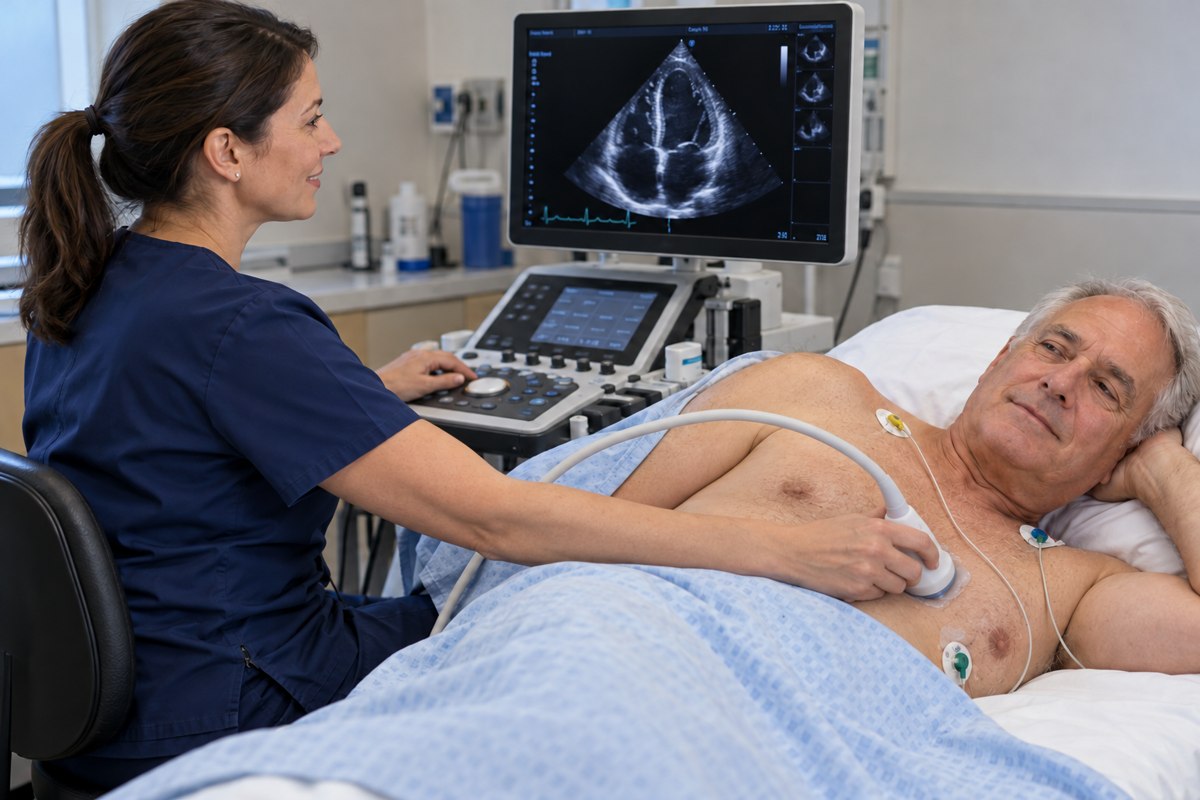
2. An echocardiogram: an ultrasound of your heart
An echocardiogram, often called an echo, uses sound waves to create moving pictures of your heart. During a standard echo, a technician places an ultrasound probe on your chest.
The test helps your doctor assess:
- Your ejection fraction, or pumping strength.
- The size of your heart’s chambers.
- The thickness of the heart muscle.
- Whether your heart valves work properly.
- How your heart relaxes and fills.
A normal EF does not rule out heart failure. Patients with HFpEF may squeeze normally but have difficulty relaxing and abnormally high filling pressures.
3. Blood tests
Blood tests called BNP or NT-proBNP help assess strain on the heart. Your doctor interprets these results alongside your symptoms and imaging.
Other blood tests check kidney function, electrolytes such as potassium, and other problems that may affect your treatment. One blood test alone does not provide the whole picture.
4. An EKG and chest X-ray
An EKG records the heart’s electrical activity. It can identify abnormal rhythms or clues to previous heart damage.
A chest X-ray may show fluid congestion in the lungs or an enlarged heart. These tests provide useful clues, but do not replace the full evaluation.
5. Additional testing when needed
Depending on your results, your doctor may recommend a stress test, coronary artery testing, cardiac MRI, or cardiac catheterization to better understand the cause or measure pressures.
Not every patient needs every test. The goal is to understand your heart and choose the treatment that best fits your condition.
Updated October 2026. Educational information; your own care plan may differ. Medical illustrations are simplified examples for teaching.