What should I do now?
Call 911
Call 911 for severe trouble breathing at rest, chest pressure, fainting, or new confusion with severe illness. Do not drive yourself.
Contact your care team
Contact your care team promptly for increasing swelling, rapid weight change, worsening breathlessness, or needing more pillows to breathe comfortably.
Keep your care plan
Keep your treatment and follow-up plan. Bring questions, readings, and your medication list.
SECTION 1
What is heart failure?
Heart failure means your heart has difficulty meeting your body’s needs. Your heart is still beating, but it may have trouble pumping blood forward or relaxing and filling between beats. Heart failure can develop gradually or begin suddenly, and it can affect the left side, right side, or both sides of the heart.
How does a normal heart work?
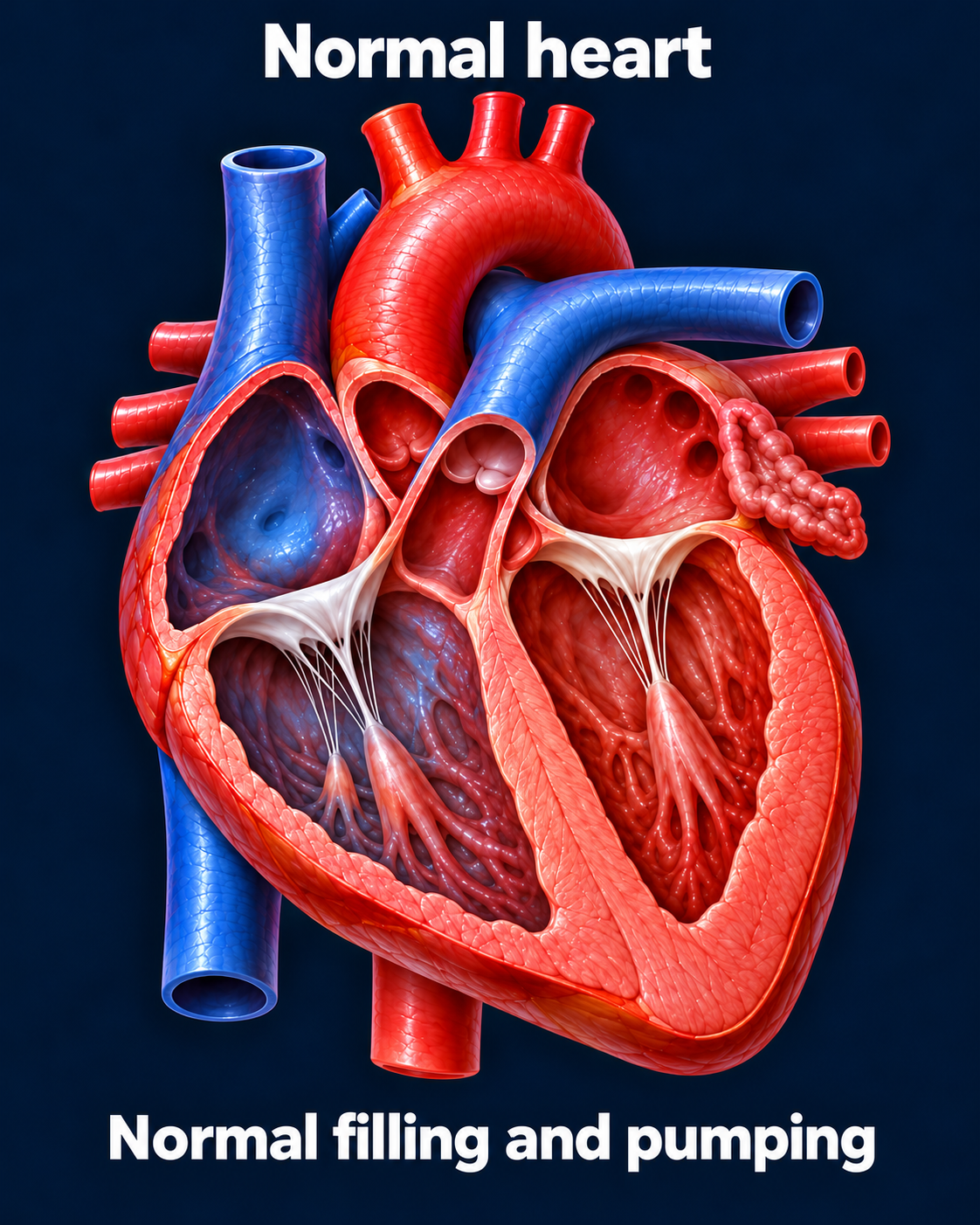
Your heart is a muscular pump with four chambers. The right side sends blood to the lungs to pick up oxygen. The left side sends oxygen-rich blood to the rest of your body.
With each heartbeat, the heart relaxes to fill with blood, then squeezes to pump blood forward. Both steps are important.
What is ejection fraction?
Ejection fraction, or EF, is the percentage of blood pumped out of the left ventricle with each heartbeat. The left ventricle is the heart’s main pumping chamber.
For example, an EF of 60% means that the chamber pumps out 60% of the blood it contains with each beat. A normal EF is generally 55%–70%. Your heart does not need to empty completely to work normally.
Two main types of heart failure
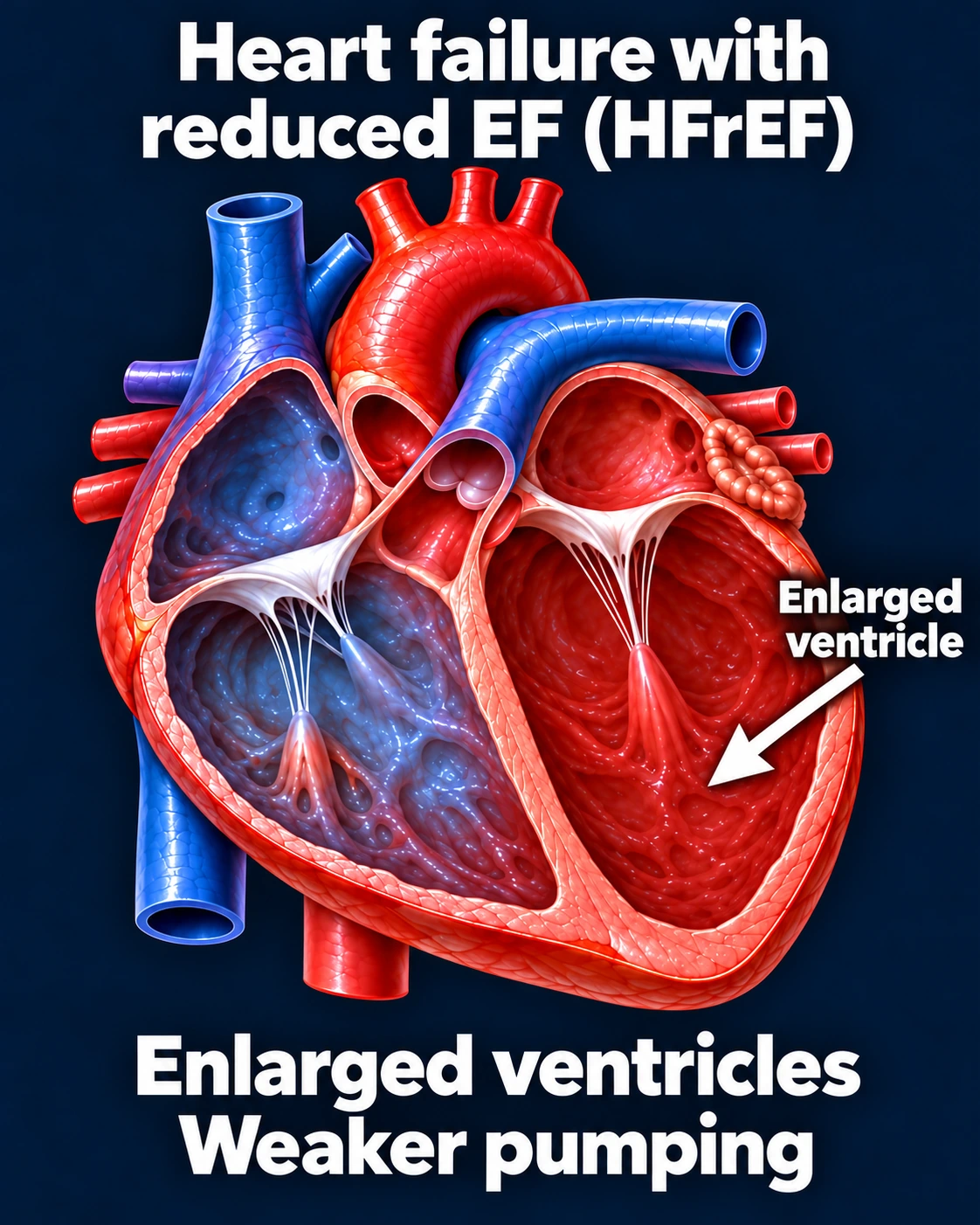
1. A weakened pump: heart failure with reduced EF
The heart muscle does not squeeze strongly enough. The left ventricle may become enlarged, and less blood moves forward with each heartbeat. This is called heart failure with reduced ejection fraction (HFrEF), typically with an EF of 40% or lower.
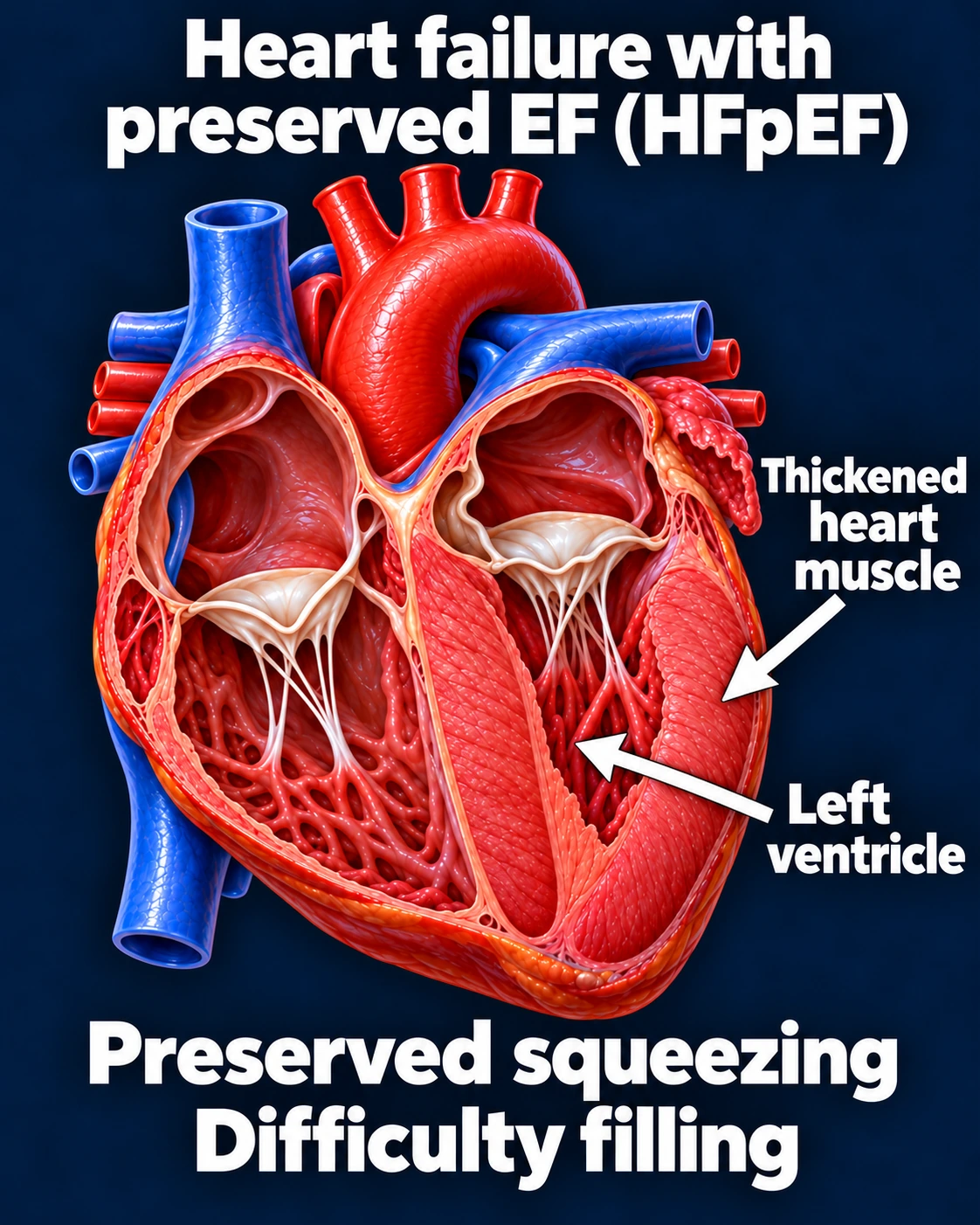
2. Difficulty filling: heart failure with preserved EF
The heart muscle is stiff and does not relax normally. Pressure rises as the heart fills, even though its squeezing strength may be preserved. This is called heart failure with preserved ejection fraction (HFpEF), with an EF of 50% or higher.
Some patients fall between these categories, with a mildly reduced EF of 41%–49%. A normal EF alone does not rule out heart failure.
Why does fluid build up?
When pressure backs up behind the heart, fluid can collect in the lungs, causing shortness of breath. Fluid can also accumulate in the legs and abdomen. The kidneys may retain extra salt and water, adding to the buildup.
When heart failure includes fluid buildup, you may hear it called congestive heart failure, or CHF.
What causes heart failure?
Common causes include:
- Coronary artery disease or a previous heart attack.
- Long-standing high blood pressure.
- Heart valve problems.
- Heart muscle disease, including inherited conditions.
- Certain persistent fast or abnormal heart rhythms.
Identifying the cause helps your doctor choose the right treatment.
Can heart failure improve?
Heart failure is serious, but treatment can help many patients feel better and live more active lives. Medications, lifestyle changes, and selected devices or procedures can improve symptoms and heart function. Even when heart function improves, ongoing care remains important.
Updated October 2026. Educational information; your own care plan may differ. Medical illustrations are simplified examples for teaching.