What should I do now?
Call 911
Call 911 for chest pressure, severe trouble breathing, fainting, or severe dizziness with palpitations. Do not drive yourself.
Contact your care team
Contact your care team for new or increasingly frequent palpitations, reduced activity, or troublesome symptoms.
Keep your care plan
Keep your treatment and follow-up plan. Bring questions, readings, and your medication list.
SECTION 1
What are PACs and PVCs?
PACs and PVCs are heartbeats that happen earlier than expected. They are called premature beats. Rather than starting with the heart’s normal pacemaker, an early electrical signal starts somewhere else in the heart.
The main difference is where that signal begins:
- PAC: A premature atrial contraction starts in an upper chamber, called an atrium.
- PVC: A premature ventricular contraction starts in a lower chamber, called a ventricle.
How does the heart normally beat?
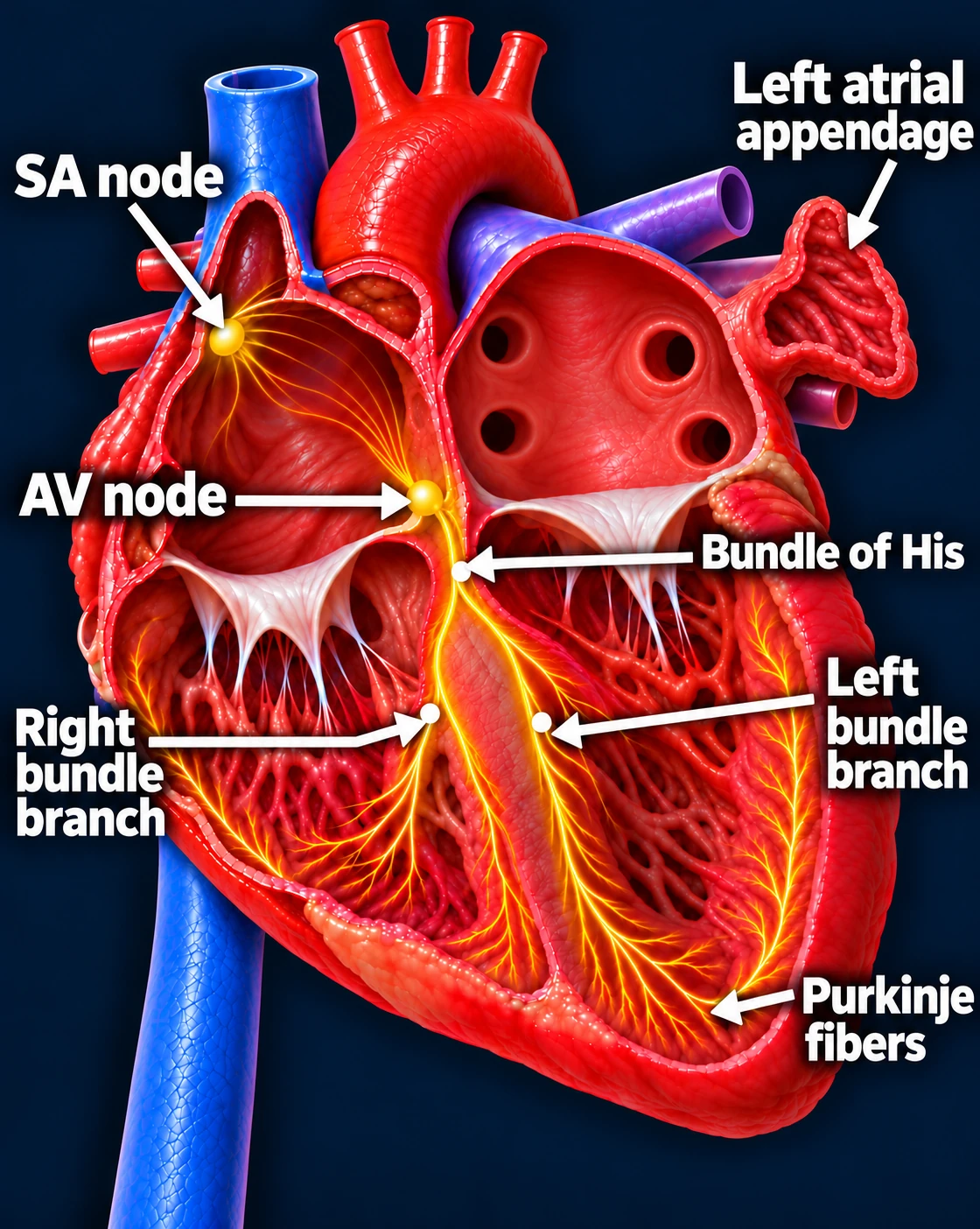
Follow one normal heartbeat
SA node → Atria → AV node → Ventricles
- The SA node starts the signal. The heart’s natural pacemaker in the right upper chamber begins each normal sinus beat.
- The signal spreads through both atria. The upper chambers contract, moving blood into the ventricles.
- The AV node briefly delays the signal. This pause gives the ventricles time to finish filling.
- The signal activates the ventricles. It travels through the bundle of His, right and left bundle branches, and Purkinje fibers. The lower chambers contract, pumping blood to the lungs and body.
The atria contract first; the ventricles follow. This organized sequence produces a coordinated heartbeat.
Sinus rhythm
What happens during a PAC?
An electrical signal starts in the atria before the next normal heartbeat is due. It usually travels through the AV node and activates the ventricles through their normal wiring.
Think of it as an upper chamber saying, “Beat now!” a little too early.
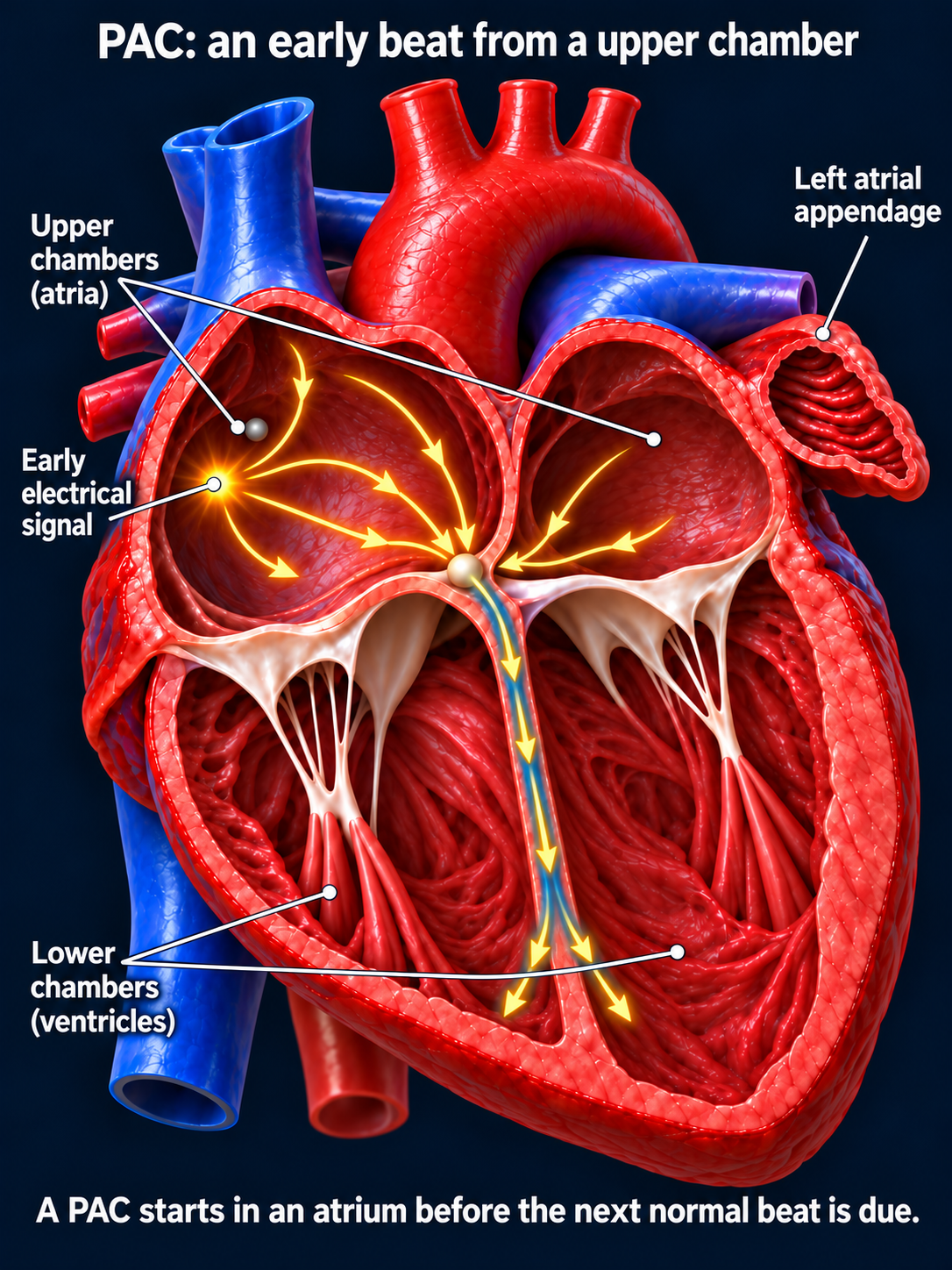
Sinus rhythm with one PAC
What happens during a PVC?
An electrical signal starts in a ventricle before the next normal heartbeat is due. Because it starts in a different location, the ventricles activate differently from a normal beat.
Think of it as a lower chamber jumping ahead of the heart’s usual timing.
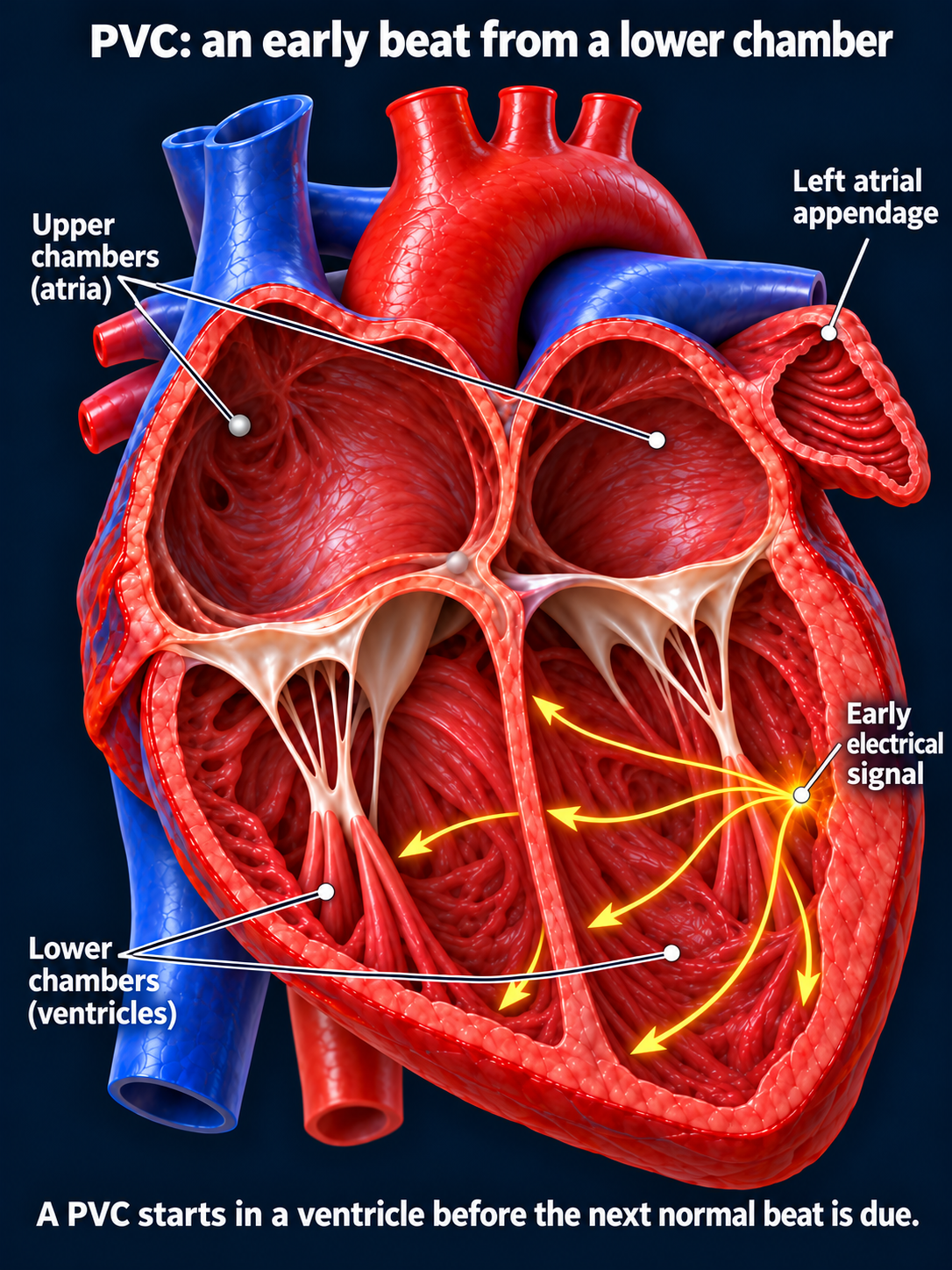
Sinus rhythm with one PVC
Why does it feel like my heart skipped a beat?
Often, your heart actually beats early rather than missing a beat. The premature beat may feel weak or go unnoticed. A pause may follow, and the next normal beat can feel stronger.
You may notice this as an early beat, a pause, then a thump. Not every premature beat produces the same sensation, and some people feel nothing at all.
Are premature beats dangerous—and when do they need treatment?
Nearly everyone has occasional premature beats—PACs, PVCs, or both. They are common and often harmless, especially when the heart is otherwise healthy. Occasional beats that cause no symptoms usually do not require treatment.
We consider treatment when premature beats cause bothersome symptoms or occur frequently enough to affect the heart’s function. Frequent PVCs can sometimes weaken the heart muscle over time, leading to heart failure. Reducing those PVCs may help the heart recover.
PACs and PVCs have different implications. The concern about weakening the heart applies mainly to frequent PVCs. Frequent PACs may warrant evaluation for other atrial rhythm problems.
Your clinician considers your symptoms, the number and type of premature beats, and your heart’s pumping function when deciding whether treatment is needed.
The key idea: PACs start in the upper chambers. PVCs start in the lower chambers. Both are early beats—but their significance depends on the individual patient.
Updated October 2026. Educational information; your own care plan may differ. Heart illustrations and EKG examples are simplified for teaching.