Understand medications, catheter ablation, and sudden-death protection with an ICD.
Choose treatment by cause and goal
Address ischemia, heart failure, electrolyte abnormalities, and medication-related triggers. For reassuring low-burden ectopy, education and individualized trigger reduction may suffice. Persistent symptoms or ventricular dysfunction changes the discussion.[1][2]
Medications
Beta blockers can reduce symptoms and arrhythmia burden. Verapamil or diltiazem may help selected idiopathic rhythms in suitable patients; reduced EF and rhythm uncertainty limit their use. Flecainide and other antiarrhythmics require specialist selection, substrate assessment, and monitoring. Avoid class IC agents in prior MI/significant structural disease. Amiodarone has important organ toxicities; sotalol requires QT and renal assessment.[3]
Catheter ablation
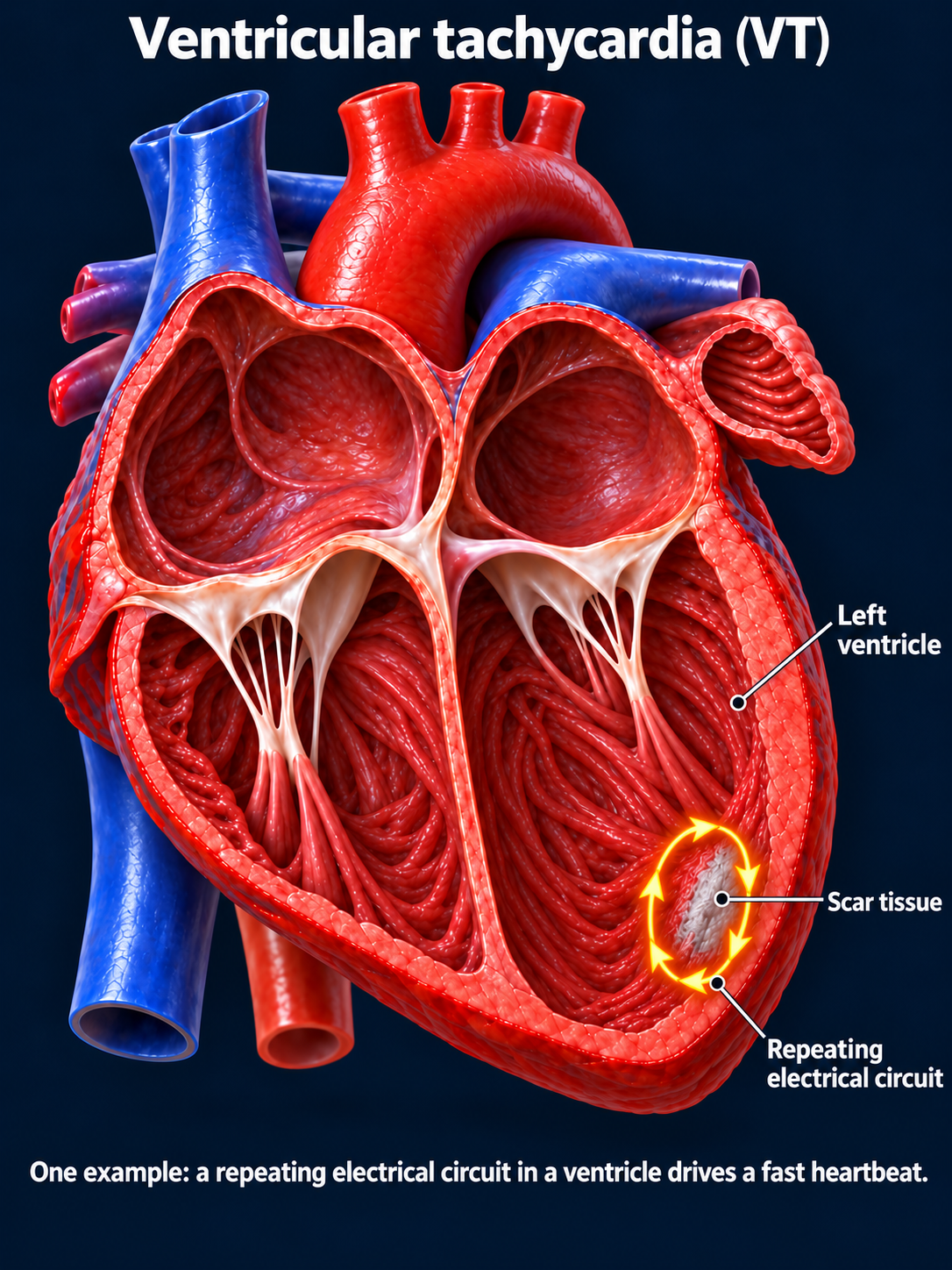
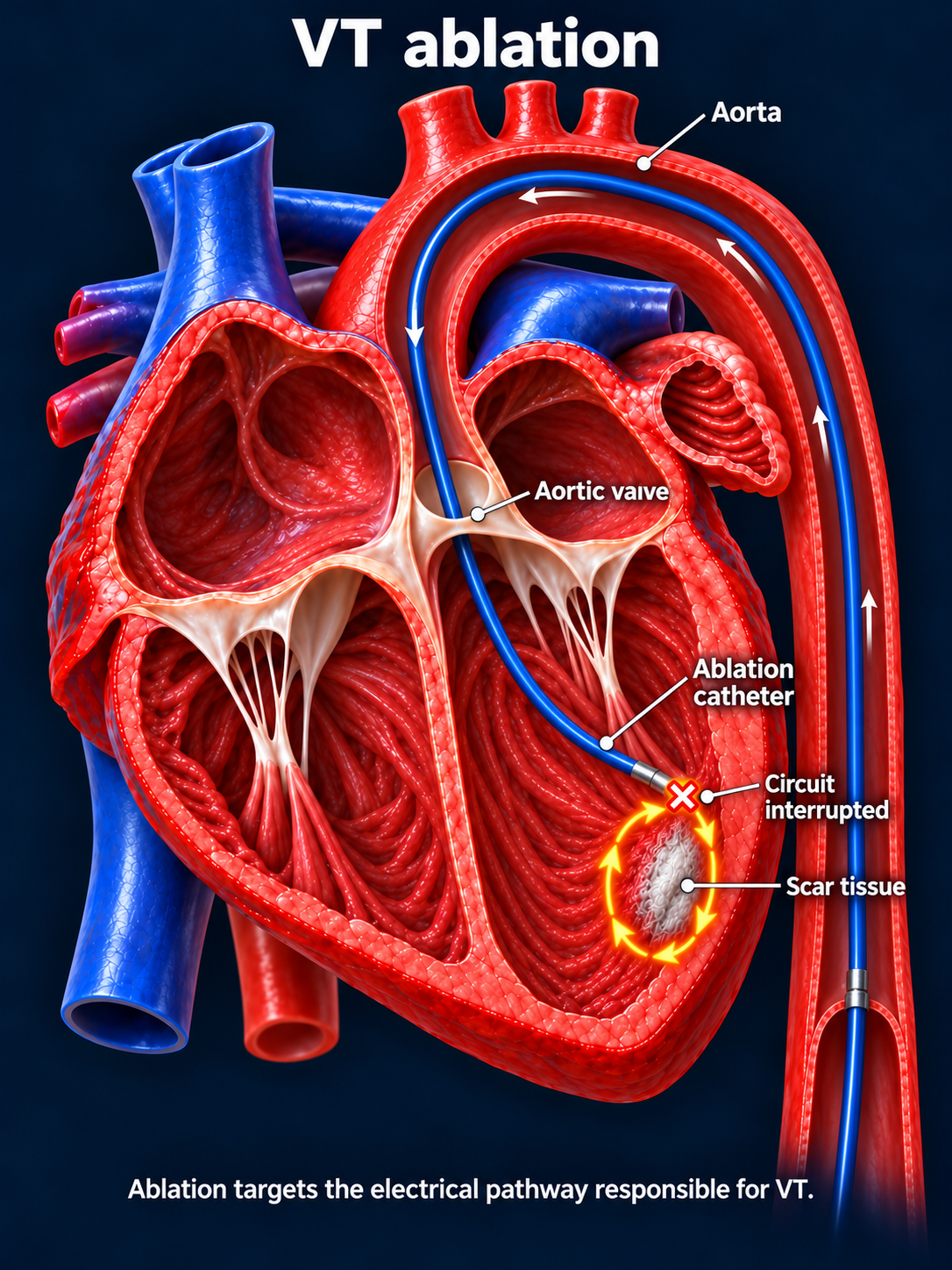
EP mapping identifies a PVC focus or the circuit sustaining VT. Ablation targets that tissue to reduce recurrence. It is particularly useful for symptomatic idiopathic PVCs/VT and suspected PVC-induced cardiomyopathy; selected idiopathic rhythms can be treated with ablation first.
One mechanism of monomorphic VT: an electrical circuit around ventricular scar. Not all VT is scar related.Open full-size image →One illustrated access route for VT ablation. The actual approach depends on the location and substrate.Open full-size image →
Scar-related VT ablation can reduce episodes and ICD therapies. Success, recurrence, and procedural risk depend on the substrate and location. Ablation usually complements an ICD when sudden-death protection remains indicated.[4][6]
When does an ICD enter the plan?
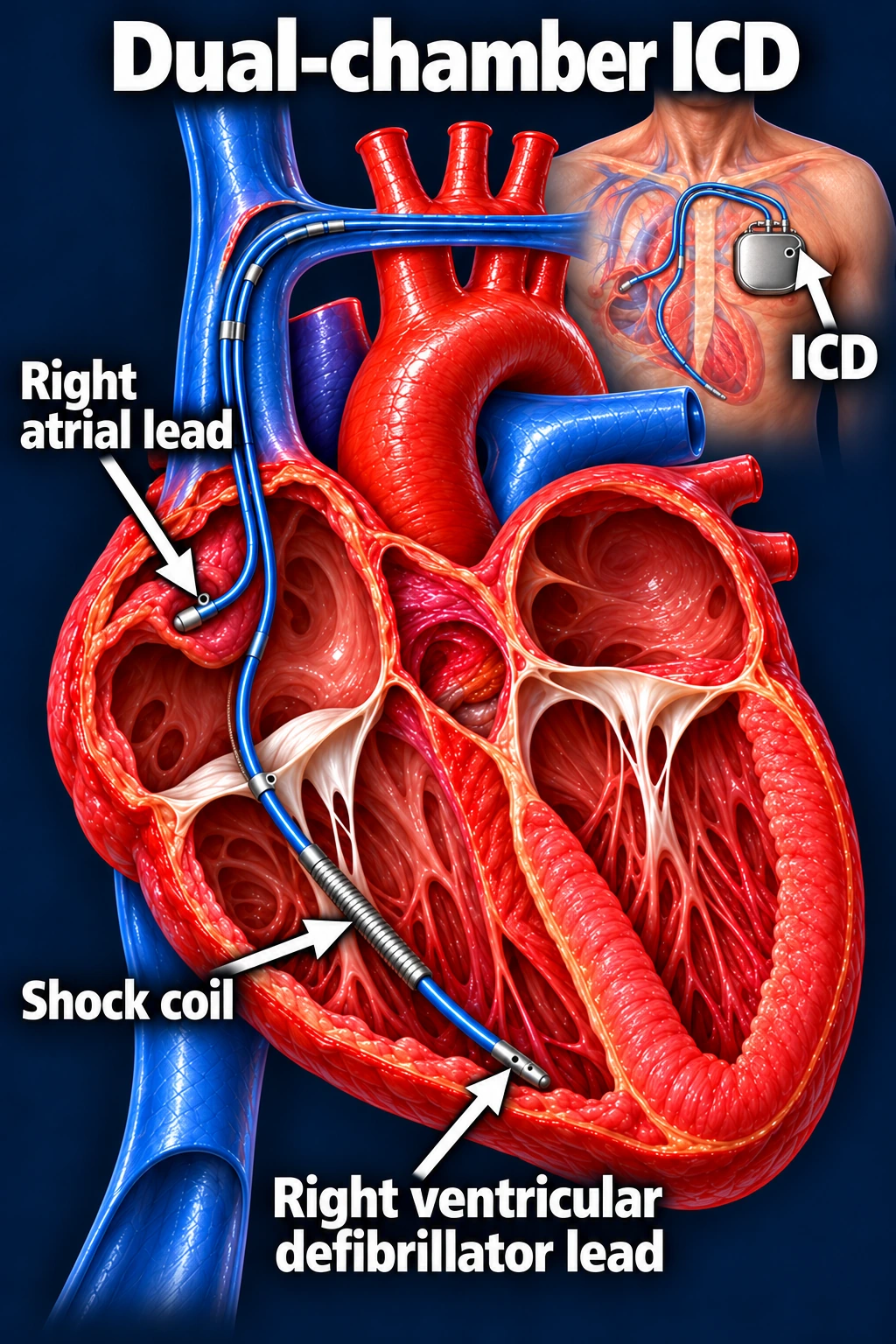
An ICD detects dangerous ventricular rhythms and delivers therapy. Transvenous systems may terminate VT with antitachycardia pacing before a shock.
A dual-chamber transvenous ICD example. Device choice follows the patient’s pacing and defibrillation needs.Open full-size image →
Secondary prevention: survivors of VT/VF arrest or qualifying sustained VT without a reversible cause often need ICD evaluation.
Primary prevention: selected cardiomyopathy patients qualify before an arrest. EF ≤35% is a common threshold, but optimal therapy, symptoms, recovery/waiting periods, expected survival, and disease-specific risk also matter.
PVCs or incidental NSVT alone do not automatically justify an ICD. An ICD treats dangerous episodes; it does not eliminate their substrate.[7][8]
Acute VT treatment is rhythm specific
Unstable monomorphic VT with a pulse requires synchronized cardioversion. Pulseless VT/VF requires CPR and defibrillation. Sustained polymorphic VT requires an immediate unsynchronized shock.
For torsades recurrence, hospital care includes IV magnesium, correcting electrolytes, and removing QT-prolonging triggers; pause-dependent cases may need pacing. These measures must not delay a required shock.[5]
Follow-up and patient counseling
Reassess symptoms, PVC burden, and ventricular function after treatment. Provide an individualized emergency and driving plan. Repeated ICD shocks or a shock with syncope, chest pain, or persistent symptoms warrants emergency care; a single shock with full recovery still requires prompt device-team contact.