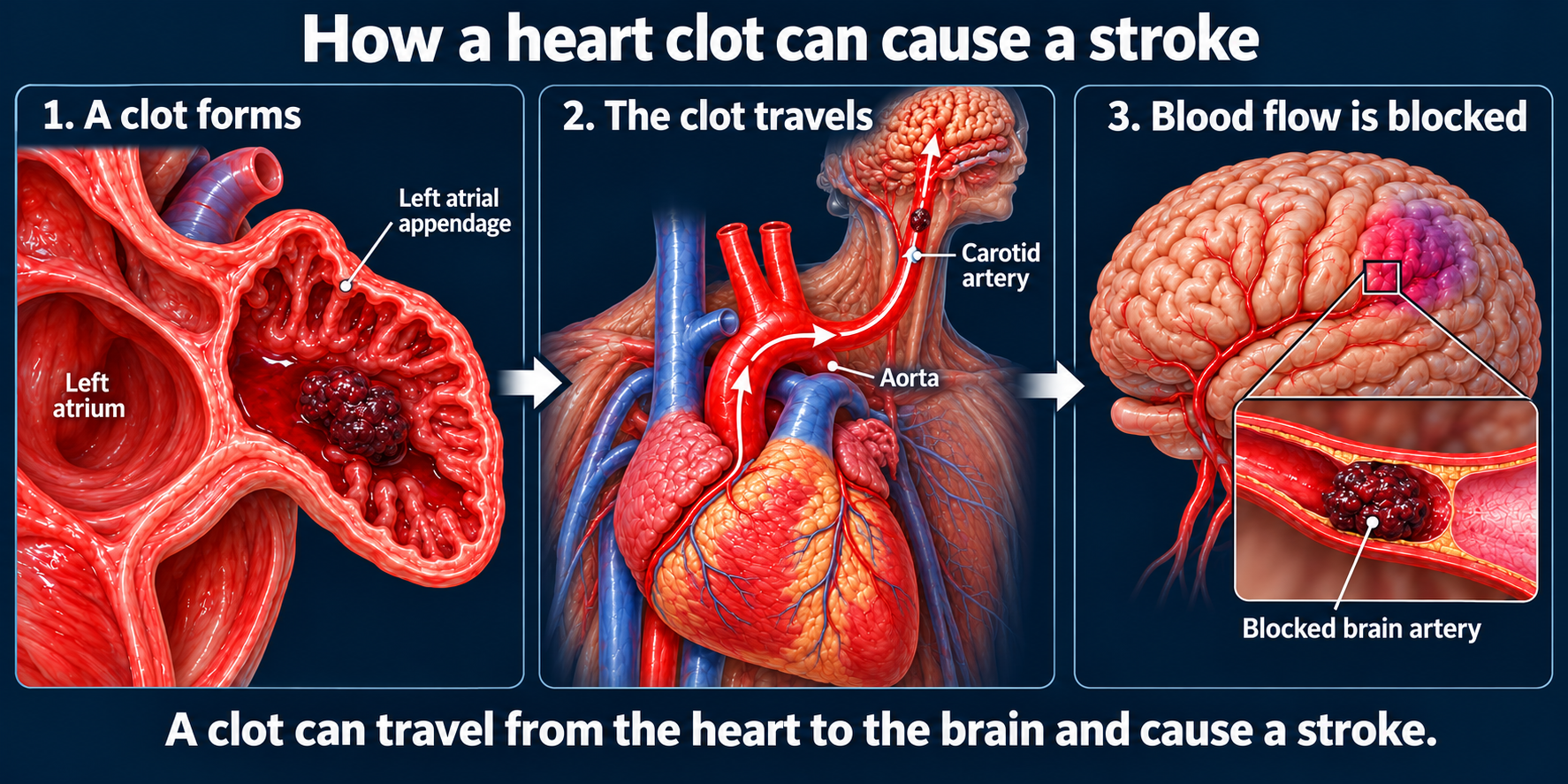
Understand embolic risk, anticoagulants, and the role of the left atrial appendage.
Stroke protection is a separate treatment goal
AF can allow blood to stagnate and form a clot, commonly in the left atrial appendage (LAA). Anticoagulation reduces clot formation; LAA closure excludes a major clot source. Neither treatment restores sinus rhythm.
Use a validated annual stroke-risk estimate. CHA₂DS₂-VASc remains a practical U.S. tool:
CHA2DS2-VASc stroke-risk score
Risk factor
Points
Heart failure/LV dysfunction
1
Hypertension
1
Age ≥75
2
Diabetes
1
Prior stroke/TIA/systemic embolism
2
Vascular disease
1
Age 65–74
1
Female sex
1
AF pattern and apparent ablation success do not independently determine whether stroke protection can stop.
1. Calculate CHA2DS2-VASc
Add the points for the patient’s stroke-risk factors. Count only one age category. Include the female-sex point in the total.
2. Start OAC at the recommended threshold
Men: score 2 or higher OAC is recommended.
Women: score 3 or higher OAC is recommended.
When this threshold is met, initiate an appropriate oral anticoagulant unless contraindicated, after reviewing bleeding concerns, renal function, interactions, and dose criteria.
Example: Hypertension (1) + diabetes (1) = 2 in a man. Adding the female-sex point gives 3 in a woman. Both meet the recommended threshold.
Intermediate risk: At 1 in men or 2 in women, OAC is reasonable after individualized discussion. Female sex alone does not justify OAC.
These thresholds apply to clinical AF/flutter. Device-detected episodes and other independent anticoagulation indications require their own assessment.
Anticoagulants and antiplatelets serve different roles
Apixaban, rivaroxaban, dabigatran, and edoxaban are direct oral anticoagulants (DOACs). Warfarin requires INR monitoring. Aspirin or clopidogrel is not an equivalent substitute for AF anticoagulation. Coronary stents may create a separate antiplatelet indication that needs coordination.
Adult U.S. dosing for stroke prevention in nonvalvular AF. These regimens are not DVT/PE treatment or postoperative prophylaxis doses. Use Cockcroft-Gault creatinine clearance (CrCl, mL/min) for renal dose decisions; apixaban also uses the age, weight, and serum-creatinine criteria below.
Apixaban (Eliquis)
Usual dose: 5 mg twice daily.
Reduced dose: 2.5 mg twice daily when at least two apply: age ≥80 years, weight ≤60 kg, serum creatinine ≥1.5 mg/dL.
Combined strong CYP3A4/P-gp inhibitors require a 50% dose reduction from 5 mg twice daily; avoid the combination if already taking 2.5 mg twice daily. Review the full interaction list. Dialysis or very advanced CKD requires individualized selection because clinical outcome data are limited.
CrCl 15–50: 15 mg once daily with the evening meal. Data below CrCl 30 are limited. CrCl <15 or dialysis requires specialist review of current labeling and evidence; do not extrapolate this routine dosing summary.
Check P-gp/CYP3A interactions. The 2.5 mg twice-daily CAD/PAD regimen is not an AF stroke-prevention dose.
CrCl 15–30: 75 mg twice daily. With CrCl 30–50 plus dronedarone or systemic ketoconazole, use 75 mg twice daily. Avoid P-gp inhibitors with CrCl 15–30.
No labeled dosing recommendation for CrCl <15 or dialysis. Swallow capsules whole. The 110 mg twice-daily AF regimen used in some countries is not a U.S. labeled AF dose.
Do not use for AF when CrCl >95 because of reduced efficacy versus warfarin. Not recommended when CrCl <15. The weight ≤60 kg and selected P-gp inhibitor dose-reduction rules in the U.S. DVT/PE label should not be carried over to AF dosing.
Individualized once-daily dose, titrated to INR. A usual initial range is 2–5 mg daily when genotype is unknown; consider lower initiation doses in older, debilitated, or particularly sensitive patients. Maintenance dosing depends on INR response.
AF INR target: 2.0–3.0 unless another indication changes the target. Check INR frequently during initiation and after interacting medicines or major dietary changes.
Warfarin is used for AF with moderate-or-greater mitral stenosis or a mechanical valve. Mechanical-valve INR targets depend on valve type and location; use the valve-specific plan.
Confirm indication, renal and liver function, CBC, weight, adherence, bleeding history, and interacting medicines. Reassess after renal deterioration or an acute illness. Use the labeled dose-reduction criteria; bleeding concern alone is not a reason to prescribe an unsupported low DOAC dose. DOACs are generally preferred over warfarin for eligible AF patients without moderate-or-greater mitral stenosis or a mechanical valve.
Dosing references reviewed October 23, 2026. Consult the linked full labels for hepatic impairment, interactions, contraindications, and special populations.